
ICSI Process Step by Step: From Ovarian Stimulation to Embryo Development

Manar Hegazy

Majd Eddin Khaled
ICSI is not simply a single laboratory procedure.
It is part of a treatment cycle that begins before egg retrieval and continues through oocyte assessment, sperm preparation, fertilization, embryo culture, and ultimately embryo transfer or freezing.
Most stages are shared with conventional IVF.
The main difference occurs during fertilization.
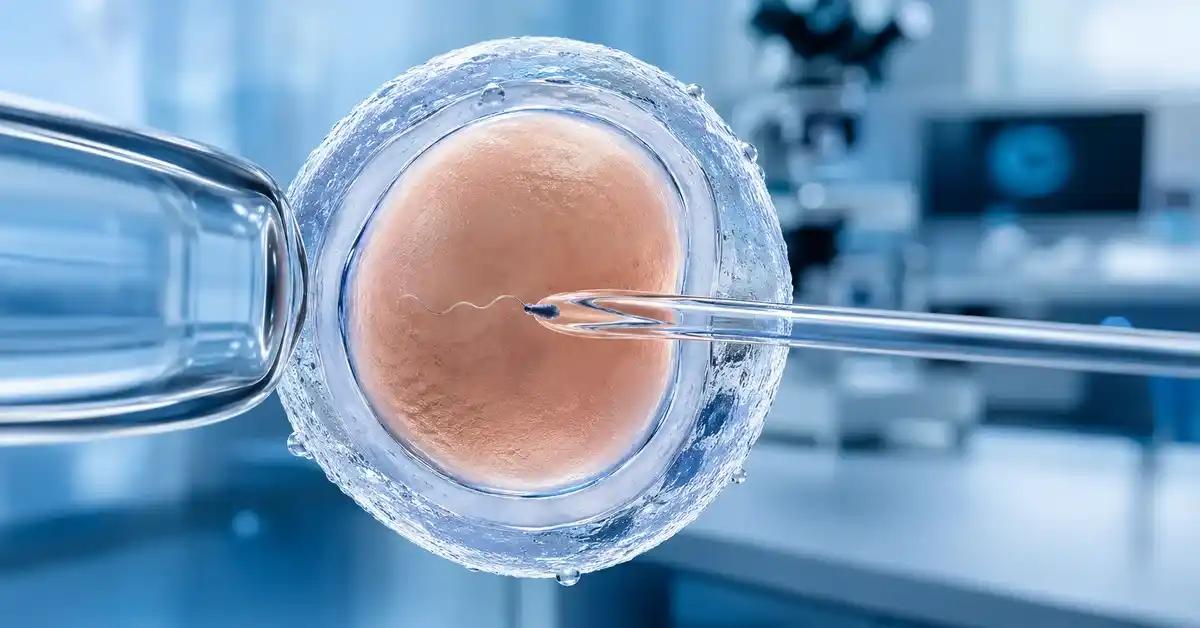
In conventional IVF, oocytes and sperm are placed together and fertilization is allowed to occur. In ICSI, an embryologist selects a sperm and injects it directly into a mature oocyte.
Fertiliv helps patients organize testing, stimulation plans, egg-retrieval results, fertilization reports, and embryo-development records and coordinate each stage of treatment.
Before ICSI: Evaluation and Treatment Planning
The cycle begins before the first stimulation injection.
The fertility team reviews both partners to understand the cause of infertility and whether ICSI is actually indicated.
Assessment may include:
Female age
Menstrual history
AMH
Antral follicle count
Pregnancy and miscarriage history
Previous surgery
Previous IVF outcomes
Semen analysis
Male medical and reproductive history
Uterine or tubal evaluation when clinically appropriate
ASRM's 2026 guidance emphasizes systematic evaluation of both partners and recommends targeted testing based on clinical history rather than indiscriminate testing.
Does Everyone Need ICSI?
No.
ICSI is particularly useful for certain male-factor situations and after previous total or unexpectedly low fertilization with conventional IVF.
Routine use in all IVF cycles without male factor or previous fertilization failure has not been shown to improve live-birth rates.
Read also: IVF vs ICSI: What Is the Difference and When Is Each Treatment Used?
Ovarian Stimulation and Follicle Monitoring
Stimulation medications encourage a group of follicles to grow during the treatment cycle.
The physician determines:
Stimulation protocol
Starting gonadotropin dose
Timing of medication
Strategy to prevent premature ovulation
Monitoring schedule
The plan may depend on:
AMH
AFC
Age
Previous ovarian response
OHSS risk
Other patient-specific factors
How Is Response Monitored?
Transvaginal ultrasound is commonly used to assess:
Number of follicles
Follicle sizes
Overall growth pattern
Hormonal blood tests may also be used when clinically useful.
The goal is not to make every follicle identical in size but to identify an appropriate time for final maturation.
Read also: ICSI Stimulation Protocols: How Is the Right Treatment Plan Chosen?
Final Maturation and Egg Retrieval
When the follicular cohort is considered ready, final oocyte maturation is triggered.
Depending on the protocol, this may involve:
hCG
A GnRH agonist
Another individualized strategy
The interval between trigger administration and egg retrieval is carefully planned.
What Happens During Egg Retrieval?
Under appropriate anesthesia or sedation, an ultrasound-guided needle is passed through the vaginal wall to aspirate follicular fluid.
The fluid is transferred to the embryology laboratory, where oocytes are identified.
Do Follicle and Oocyte Numbers Match?
Not necessarily.
For example:
10 follicles
may result in:
7 retrieved oocytes
of which:
5 or 6 may be mature.
Read also: Why Do Egg and Embryo Numbers Drop During IVF? From Follicles to Embryos Step by Step
Preparing Oocytes for ICSI
Before ICSI, surrounding cumulus cells are removed so the embryologist can assess oocyte maturity.
ESHRE's updated 2026 IVF laboratory recommendations advise minimizing unnecessary enzyme exposure and mechanical trauma during this step and documenting oocyte maturity before injection.
Oocyte Maturity Stages
Oocytes may be classified as:
MII: mature and usually suitable for ICSI
MI: immature
GV: earlier immature stage
Degenerated oocytes may also be identified and would not normally be used.
Are All Retrieved Oocytes Injected?
No.
ICSI is generally performed on mature, suitable oocytes.
A cycle might therefore progress as:
8 retrieved → 6 mature → 6 injected
Read also: Why Are Some Eggs Immature After Retrieval? Causes and Impact on IVF and ICSI
Sperm Preparation and the ICSI Procedure
A semen sample is prepared in the laboratory to separate sperm suitable for use from seminal plasma, cells, debris, and other material.
ESHRE's 2026 recommendations emphasize validated sperm-preparation procedures, patient identification, witnessing, and traceability throughout laboratory treatment.
What Happens During ICSI?
In simplified terms:
A mature oocyte is stabilized.
The embryologist selects a sperm for injection.
The sperm is drawn into a fine injection pipette.
The pipette passes through the zona pellucida and oocyte membrane.
The sperm is deposited into the ooplasm.
The oocyte is returned to controlled culture conditions.
This is the defining difference between ICSI and conventional IVF.
Does Selecting One Sperm Guarantee a Healthy Embryo?
No.
Sperm selection is based on characteristics that can be assessed in the laboratory, but it cannot reveal every genetic or biological feature of the sperm.
The oocyte must also be biologically capable of completing fertilization and supporting early embryo development.
Can an Oocyte Degenerate After ICSI?
Yes.
Most mature oocytes tolerate injection, but a small proportion may degenerate afterward.
ESHRE therefore emphasizes trained operators and controlled laboratory conditions during ICSI.
Fertilization Check and Embryo Development
Injecting a sperm does not itself prove that fertilization has occurred.
The oocytes return to culture and are assessed the following day.
ESHRE guidance notes that insemination or injection timing should allow fertilization assessment around 16–17 hours later.
What Does Normal Fertilization Look Like?
The laboratory typically looks for two pronuclei.
This is often reported as:
2PN
representing the maternal and paternal pronuclei before they merge.
For example:
6 injected oocytes → 5 normally fertilized oocytes
A nonfertilized oocyte may still have been successfully injected but failed to complete normal fertilization.

What Happens After Fertilization?
A simplified timeline is:
Day 1: fertilization assessment
Days 2–3: cleavage-stage development
Around Day 4: morula stage
Days 5–6: blastocyst development may occur
Not all embryos develop at the same rate.
Some reach blastocyst on Day 5, others on Day 6, and some stop developing before reaching that stage.
Read also: Why Don’t Some Embryos Reach Day 5? Causes of Embryo Arrest Before the Blastocyst Stage
Fresh Transfer, Freezing, and PGT
Once suitable embryos develop, the team decides whether embryo transfer will occur in the same cycle or later.
Fresh Embryo Transfer
Fresh transfer may be considered when:
The patient is medically suitable
Endometrial conditions are appropriate
OHSS risk is acceptable
No specific reason exists to delay transfer
Freeze-All
All suitable embryos may instead be frozen when:
OHSS risk is elevated
Embryo genetic testing is planned
Endometrial or hormonal conditions are unsuitable
Another medical reason favors delaying pregnancy
Freeze-all does not mean ICSI has failed.
It may be an intentional part of the treatment strategy.
Where Does PGT Fit?
Embryos undergoing PGT generally need to reach a suitable blastocyst stage for biopsy and are typically frozen while results are pending.
However, PGT-A itself does not automatically require ICSI in every patient.
ASRM's 2026 committee opinion states that, in the absence of male-factor infertility, using ICSI for PGT-A has not been shown to improve embryo number, euploidy rates, or live-birth rates compared with conventional insemination. ICSI may be appropriate for PGT-M to reduce contamination risk.
Read also: IVF With PGT-A and PGT-M in Istanbul
How Should You Read an ICSI Cycle Result?
An ICSI cycle should not be judged from one number.
The full pathway is:
follicles → retrieved oocytes → mature oocytes → injected oocytes → normally fertilized oocytes → developing embryos → blastocysts → embryos suitable for transfer or freezing
A Practical Example
Suppose monitoring shows:
12 follicles
Egg retrieval produces:
10 oocytes
After maturity assessment:
8 are mature
ICSI is performed on all eight.
The following day:
6 show normal fertilization
By Day 3:
5 continue developing
By Days 5–6:
3 suitable blastocysts develop
This stepwise reduction is not necessarily evidence that something went wrong.
It reflects biological selection at multiple stages.
What If the Numbers Are Lower Than Expected?
The useful question is:
Where did the largest drop occur?
Was it:
Between follicles and retrieval?
Between retrieval and maturity?
At fertilization?
During embryo development?
Before blastocyst formation?
Each pattern leads to a different clinical review.
Conclusion
ICSI is one component of a complete fertility-treatment cycle rather than simply the moment when a sperm is injected into an oocyte.
The pathway usually includes:
evaluation → ovarian stimulation → follicle monitoring → final maturation → egg retrieval → maturity assessment → sperm preparation → ICSI → fertilization check → embryo culture → transfer or freezing
The defining difference from conventional IVF is the method of fertilization.
ICSI does not guarantee that every mature oocyte will fertilize, that every fertilized oocyte will become an embryo, or that every embryo will reach blastocyst.
Cycle results should therefore be interpreted stage by stage.
ICSI itself should also be selected for an appropriate clinical reason, because routine use in patients without male-factor infertility or previous fertilization failure has not been shown to improve live-birth outcomes.
Fertiliv helps patients organize treatment stages and embryology reports and coordinate review of ICSI results before planning the next step.
Frequently Asked Questions: ICSI Process Step by Step: From Ovarian Stimulation to Embryo Development
How Long Does an ICSI Cycle Take?
Timing varies by protocol and ovarian response, but stimulation, monitoring, retrieval, and embryo culture typically occur over several days to approximately two weeks before embryo transfer decisions.
Are All Retrieved Oocytes Injected?
No. ICSI is usually performed on mature oocytes that are suitable for injection.
What Is the Main Difference Between IVF and ICSI?
The key difference is fertilization: ICSI injects one sperm directly into an oocyte, while conventional IVF allows sperm and oocytes to fertilize together.
When Do We Know Whether ICSI Worked?
Fertilization is usually assessed the following day by looking for normal fertilization markers.
Does Every Fertilized Oocyte Reach Day 5?
No. Some embryos stop developing before blastocyst.
Must Embryo Transfer Occur in the Retrieval Cycle?
No. Embryos may be transferred fresh or frozen for transfer in a later cycle.
Does ICSI Guarantee Fertilization?
No. ICSI may reduce fertilization failure in selected situations but cannot guarantee fertilization of every oocyte.
Does Every IVF Patient Need ICSI?
No. The choice depends on infertility diagnosis, semen findings, previous fertilization history, and treatment strategy.