
IVF vs ICSI: What Is the Difference and When Is Each Treatment Used?

Manar Hegazy

Majd Eddin Khaled
IVF and ICSI are often discussed as if they were two completely different fertility treatments.
In reality, most stages of the treatment cycle are similar.
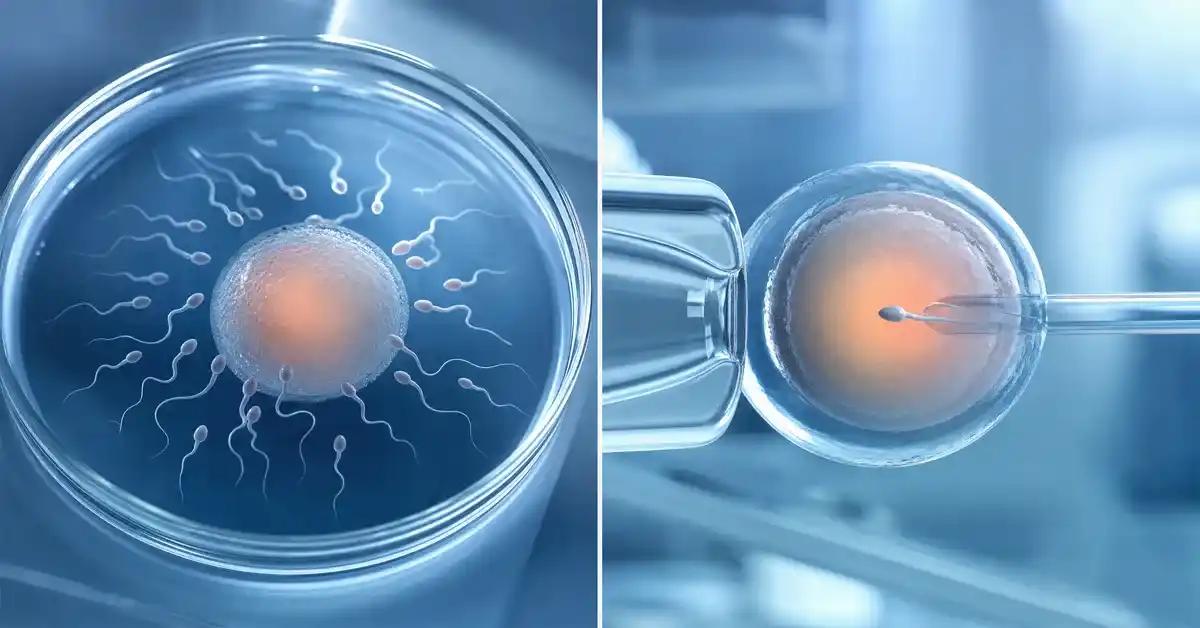
The main difference is how fertilization takes place in the laboratory.
With conventional IVF, mature eggs are placed with sperm so fertilization can occur without directly injecting a sperm cell into the egg.
With intracytoplasmic sperm injection, one selected sperm is injected directly into a mature egg.
The key question is therefore not simply:
“Which one is better?”
It is:
“Which fertilization method has a clear reason to be used in our case?”
Fertiliv helps patients organize fertility tests and previous treatment records so the medical and laboratory team can select an appropriate treatment strategy.
What Is Conventional IVF?
After ovarian stimulation and egg retrieval, mature oocytes are placed with prepared sperm in the laboratory.
Fertilization depends on sperm reaching and penetrating the egg under laboratory conditions.
The resulting embryos are then monitored before transfer or freezing.
Conventional IVF can be appropriate when sperm parameters and previous treatment history do not suggest a high risk of fertilization failure.
Read also: IVF in Turkey: Complete Patient Guide
What Is ICSI?
ICSI is a laboratory fertilization technique in which an embryologist selects one sperm and injects it directly into a mature oocyte.
It was developed primarily to overcome important male-factor fertilization problems.
It can also be considered in selected situations based on previous fertilization history, sperm source, oocyte status, or genetic-testing strategy.
The rest of the IVF pathway—stimulation, retrieval, embryo culture, freezing, and transfer—can otherwise be similar.
IVF vs ICSI at a Glance
| Feature | Conventional IVF | ICSI |
|---|---|---|
| Fertilization | Eggs and sperm are placed together | One sperm is injected into each selected mature egg |
| Individual sperm injection | No | Yes |
| Common indication | Suitable sperm and no major fertilization concern | Particularly useful for male-factor infertility |
| Bypasses sperm penetration of the egg | No | Yes |
| Needed for every patient | No | No |
| Guarantees fertilization | No | No |
| Guarantees pregnancy | No | No |
When Is ICSI Particularly Useful?
ICSI may be especially relevant when there is a significant male factor, such as:
Very low sperm concentration
Severely reduced motility
Significant sperm abnormalities
Surgically retrieved sperm
Previous poor or failed fertilization with conventional IVF
Previously cryopreserved oocytes
Selected genetic-testing situations
Male infertility should be assessed as part of the complete clinical picture rather than from one semen parameter alone.
Read also: IVF and Micro-TESE in Istanbul for Azoospermia Treatment
Is ICSI Always Better?
No.
The American Society for Reproductive Medicine stated in its updated 2026 committee opinion that routine ICSI for all oocytes in patients without male-factor infertility or previous fertilization failure does not improve live-birth rates.
ICSI is therefore not automatically a stronger or more successful version of IVF.
When semen parameters are suitable and there is no history of fertilization failure, routine ICSI may provide no proven live-birth advantage over conventional IVF.
Why Is ICSI Used So Often?
ICSI bypasses one major biological step: sperm penetrating the egg.
This is highly valuable when that step is likely to be difficult.
It may also reduce the risk of another fertilization failure in selected patients with a previous history of unexpectedly poor fertilization.
However, reducing fertilization failure in a selected case is not the same as improving live birth for every IVF patient.
What If the Sperm Count Is Very Low?
When very few usable sperm are available, conventional insemination may not be practical.
ICSI allows an embryologist to use a selected sperm for each mature oocyte chosen for injection.
When sperm are absent from the ejaculate, surgical retrieval may be considered in selected male-factor cases and retrieved sperm may then be used with ICSI.
The possibility of successful retrieval depends on the underlying diagnosis and cannot be guaranteed.
What If the Semen Analysis Is Normal?
In the absence of male-factor infertility, the case for routine ICSI becomes much weaker.
The American Society for Reproductive Medicine does not recommend routine ICSI solely because of:
Advanced maternal age
Diminished ovarian reserve
Low oocyte yield
Unexplained infertility alone
PGT-A alone
Some studies may show differences in fertilization outcomes, but these have not translated into improved live-birth outcomes for these indications.
What If Fertilization Failed in a Previous IVF Cycle?
This is different.
If conventional IVF previously resulted in complete fertilization failure or unexpectedly poor fertilization, ICSI may be considered during the next cycle.
Here the decision is based on actual evidence from the patient's previous treatment rather than routine use.
A detailed embryology report is therefore especially valuable when planning another IVF attempt.
Read also: What Should You Do If IVF Fails in Your Home Country and You Want Treatment in Turkey?
Does ICSI Improve Embryo Quality?
Not necessarily.
ICSI changes how sperm enters the egg.
It does not correct every problem related to:
Oocyte quality
Sperm genetics
Embryo development
Chromosomal abnormalities
Maternal age
An egg can fertilize successfully and the resulting embryo may still stop developing later.
Fertilization, embryo development, implantation, pregnancy, and live birth are different outcomes.
Does ICSI Increase Pregnancy Rates?
For severe male-factor infertility, ICSI can be essential in achieving fertilization that may otherwise be difficult.
But in patients without male-factor infertility, routine ICSI has not been shown to improve live birth compared with conventional IVF.
It is important to distinguish between:
fertilization rate
pregnancy rate
and
live-birth rate.
Does Female Age Determine IVF or ICSI?
Female age is extremely important for overall IVF prognosis, but advanced age alone does not mean ICSI is better.
ICSI can help sperm enter an oocyte, but it does not reverse age-related chromosomal changes within the oocyte.
Current American Society for Reproductive Medicine guidance does not support routine ICSI solely for advanced maternal age in the absence of another indication.

What About Diminished Ovarian Reserve?
When only a few oocytes are expected, patients may understandably worry about losing an opportunity to fertilization failure.
However, current evidence does not show improved live-birth outcomes from routine ICSI solely because of low oocyte yield or diminished ovarian reserve when male-factor infertility and previous fertilization failure are absent.
Individual cases can differ, so laboratory and clinical history still matter.
Is ICSI Necessary With PGT?
Not always.
Historically, ICSI was frequently used with preimplantation genetic testing to minimize contamination from sperm surrounding the oocyte.
With modern genetic techniques, the issue is more nuanced.
According to the American Society for Reproductive Medicine, ICSI used only because PGT-A is planned does not improve embryo number, euploidy rate, or live birth when male-factor infertility is absent.
ICSI may still be appropriate in selected PGT-M situations where reducing contamination from extraneous sperm is important.
Read also: IVF With PGT-A and PGT-M in Istanbul
Are the Other Treatment Steps Different?
Most stages are similar.
Both pathways may include:
ovarian stimulation → monitoring → final trigger → egg retrieval
The main laboratory difference then appears:
Conventional IVF: eggs are exposed to sperm.
ICSI: one sperm is injected directly into each selected mature egg.
After fertilization:
embryo culture → transfer or freezing → follow-up
can proceed similarly.
Does ICSI Cost More?
ICSI requires additional laboratory micromanipulation and expertise.
Its effect on total cost depends on the treatment package and provider.
Cost alone should not determine the choice.
Likewise, a more technically intensive procedure should not be chosen simply because it appears more advanced.
The key question remains whether ICSI has a clinical or laboratory indication in the individual case.
Read also: ICSI Cost in Turkey 2026: Price, Medications, and Extra Costs
How Is the Decision Made?
The treatment team may consider:
Semen Analysis
Concentration, motility, morphology, and overall male-factor findings.
Previous Fertilization History
Was fertilization normal, poor, or absent?
Sperm Source
Was sperm ejaculated or surgically retrieved?
Oocyte Status
Are the oocytes fresh or previously cryopreserved?
Genetic Testing Plan
Which type of testing is being considered?
The Couple's Full Treatment History
No single factor should automatically determine the decision.
Can IVF and ICSI Be Used in the Same Cycle?
In selected situations, mature oocytes may be divided between conventional IVF and ICSI.
This approach can help answer a specific fertilization question when there are enough oocytes and an appropriate clinical reason.
It is not necessary for every patient.
Practical Decision Table
| Situation | Possible Approach |
|---|---|
| Suitable semen parameters and no previous fertilization failure | Conventional IVF may be appropriate |
| Severe male-factor infertility | ICSI is often more appropriate |
| Surgically retrieved sperm | ICSI is commonly required |
| Previous poor/failed conventional fertilization | ICSI may be considered |
| Advanced maternal age alone | Does not automatically justify ICSI |
| Diminished ovarian reserve alone | Does not automatically justify routine ICSI |
| PGT-M for a monogenic condition | ICSI may be appropriate |
| PGT-A alone | Does not automatically require ICSI |
Questions to Ask Before Treatment
Ask:
Is there a male-factor indication for ICSI?
What happened with fertilization in previous cycles?
Why are you recommending IVF or ICSI in our case?
Is there evidence that ICSI offers a benefit for us?
Does sperm source affect the decision?
Does the planned genetic test affect fertilization method?
Is ICSI included in the treatment cost?
What would happen if fertilization is unexpectedly poor?
Conclusion
IVF and ICSI are not completely separate treatment programs.
Their main difference lies in how the oocyte is fertilized in the laboratory.
In conventional IVF, sperm fertilizes the egg without direct injection.
In ICSI, one sperm is injected directly into a mature oocyte.
ICSI is an important technique, particularly for severe male-factor infertility and selected patients with previous fertilization failure.
However, routine ICSI for every IVF patient does not automatically improve the chance of live birth.
The better question is not:
“Which technique is more advanced?”
It is:
“Which fertilization method has a clear indication in our case?”
Fertiliv helps couples organize fertility testing and previous treatment records and coordinate medical review before selecting an IVF or ICSI treatment strategy.
Frequently Asked Questions: IVF vs ICSI: What Is the Difference and When Is Each Treatment Used?
What Is the Main Difference Between IVF and ICSI?
The difference is fertilization. Conventional IVF places eggs with sperm, while ICSI injects one sperm directly into a mature egg.
Is ICSI Better Than IVF?
Not for every patient. It is particularly useful when male-factor infertility or previous fertilization problems are present.
Does ICSI Increase Pregnancy Rates?
It can improve fertilization in selected cases, but routine ICSI does not automatically improve live-birth rates for all patients.
Does Advanced Maternal Age Require ICSI?
No. Age alone is not a proven reason for routine ICSI when no other indication exists.
Is ICSI Used With Surgically Retrieved Sperm?
Commonly, yes, because the available sperm number may be limited.
Does Low Ovarian Reserve Require ICSI?
Not automatically. Diminished ovarian reserve alone does not prove that ICSI improves live birth.
Is ICSI Required for PGT?
Not for every type of PGT. The decision depends on the genetic test, male factor, and laboratory strategy.
Can the Fertilization Method Change After a Failed IVF Cycle?
Yes. Previous poor or failed fertilization may justify reconsidering ICSI in a later cycle.