
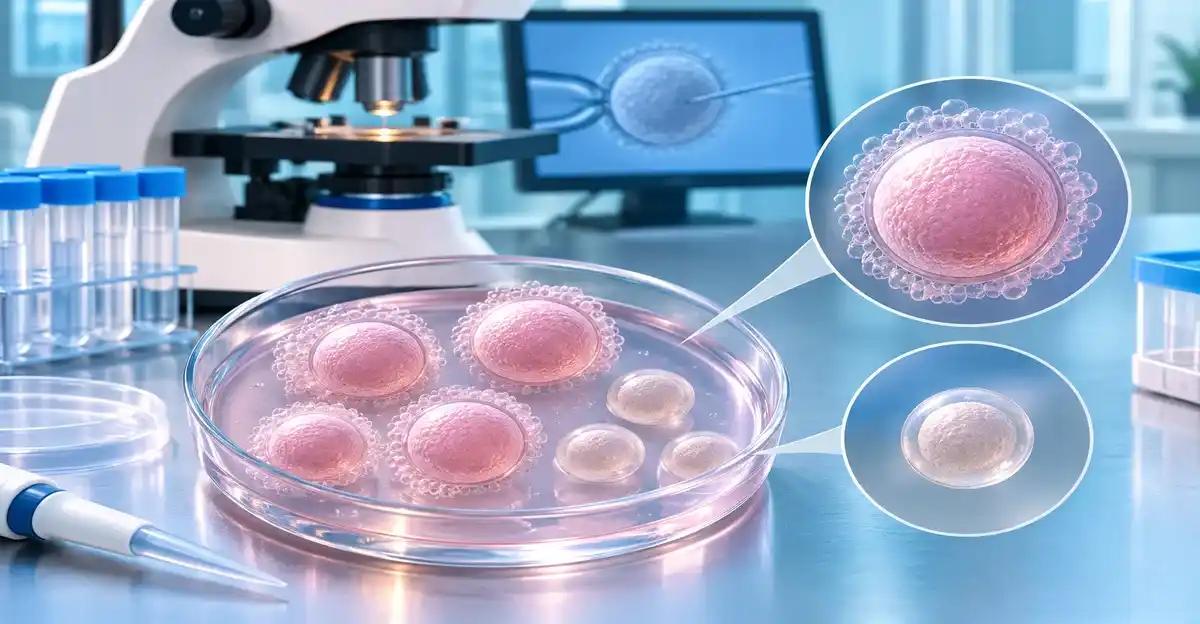
Why Are Some Eggs Immature After Retrieval? Causes and Impact on IVF and ICSI

Manar Hegazy

Majd Eddin Khaled
After egg retrieval, a patient may hear:
“Ten eggs were retrieved, but only seven were mature.”
This immediately raises questions.
What happened to the other three eggs? Why were they immature even though follicles appeared to be growing well on ultrasound?
Some immature oocytes can be found after retrieval during IVF and ICSI cycles, and this does not automatically indicate that treatment was performed incorrectly.
The more important questions are:
How many oocytes were retrieved?
How many were mature?
Was the maturity rate broadly expected or unusually low?
Has this happened before?
Does anything need to be reviewed before another cycle?
Fertiliv helps patients organize retrieval and laboratory reports and coordinate review of whether an unexpectedly low maturity rate should influence future treatment planning.
Retrieved Eggs and Mature Eggs Are Not the Same Number
After retrieval, embryologists assess the developmental stage of each oocyte.
Important stages include:
Germinal vesicle stage, or GV
Metaphase I, or MI
Metaphase II, or MII
An MII oocyte is generally considered mature and suitable for ICSI.
A laboratory report may therefore show:
12 oocytes retrieved → 9 mature oocytes → 3 immature oocytes
This is why the retrieval number should not be assumed to equal the number available for fertilization.
Read also: Why Do Egg and Embryo Numbers Drop During IVF? From Follicles to Embryos Step by Step
Why Are Some Oocytes Immature at Retrieval?
Follicles do not all develop at exactly the same speed.
At the time of final maturation, a patient may have:
Larger follicles
Intermediate follicles
Smaller follicles
The oocytes within these follicles may therefore be at different developmental stages.
Ultrasound shows follicle size, not the exact maturity stage of the oocyte inside.
Follicle Size Is an Indicator, Not a Guarantee
Larger follicles are generally more likely to contain mature oocytes than very small follicles, but no single follicle measurement can guarantee MII maturity.
This is one reason final maturation timing is based on the overall follicular cohort rather than one follicle alone.
Read also: IVF Process Step by Step: From Ovarian Stimulation to Embryo Transfer
Why Does the Trigger Matter?
Before retrieval, medication is given to induce final oocyte maturation.
Its purpose is not to create new follicles. It helps oocytes within responding follicles complete the final stages of maturation.
Therefore:
trigger type + trigger timing + retrieval timing
are important elements of the cycle.
The European Society of Human Reproduction and Embryology recommends that final maturation timing be based on the overall treatment picture, including follicle sizes, follicle number, stimulation duration, and other clinical factors.
Do Immature Eggs Mean the Trigger Was Mistimed?
Not necessarily.
Some immature oocytes can occur despite appropriate stimulation and trigger timing because follicular growth is not perfectly synchronized.
However, if an unusually large proportion of retrieved oocytes is immature—particularly when the pattern repeats—the team may review:
Follicle sizes at trigger
Trigger type
Trigger timing
Retrieval timing
Follicular synchrony
Previous stimulation protocol
Current ESHRE guidance also identifies high immature-oocyte rates as an area where more research is needed to determine the best protocol modifications.
Why Can Follicles Grow Unevenly?
A cohort of follicles may begin the cycle at different sizes.
Some respond faster than others.
This can result in a group containing both relatively advanced follicles and smaller follicles on trigger day.
The treatment team must balance waiting for smaller follicles against allowing larger follicles to progress too far.
Complete synchronization is therefore not always possible.
Does More Stimulation Medication Improve Maturity?
Not automatically.
Higher gonadotropin doses do not guarantee that every retrieved oocyte will reach MII.
Stimulation supports follicular growth, but final oocyte maturation involves additional biological processes and the timing of the final trigger.
Read also: How Is an IVF Treatment Plan Chosen and Why Does It Differ Between Patients?
Why Does ICSI Usually Require a Mature Oocyte?
For ICSI, surrounding cells are removed so the embryologist can assess oocyte maturity.
A sperm is then injected into oocytes that have reached the appropriate maturation stage, usually MII.
This means:
retrieved oocyte number
can be greater than:
the number actually injected with sperm.
Read also: IVF vs ICSI: What Is the Difference and When Is Each Treatment Used?
Can an Immature Oocyte Mature Later in the Laboratory?
Sometimes.
Some immature oocytes may continue maturing after retrieval during laboratory culture.
However, this should be distinguished from formal in vitro maturation, or IVM.
Delayed Maturation After Standard Retrieval
An immature oocyte from a conventional stimulated IVF cycle may sometimes reach MII later.
In Vitro Maturation
IVM is a distinct treatment approach in which immature oocytes are intentionally retrieved and matured in laboratory conditions using a specific clinical strategy.
These are not the same scenario.
Can a Late-Maturing Oocyte Be Used for ICSI?
In selected situations, an oocyte that reaches maturity later may be considered for ICSI according to laboratory protocol.
However, reaching nuclear maturity does not necessarily mean that the oocyte has acquired the same developmental competence as one that completed maturation appropriately before retrieval.
The American Society for Reproductive Medicine explains that successful oocyte development requires coordination between nuclear maturation and cytoplasmic maturation.
An oocyte can therefore appear mature by nuclear criteria without necessarily having equivalent cytoplasmic competence.
Is IVM Routine Treatment?
No.
IVM is a recognized assisted-reproduction technique but is used in selected situations rather than as a routine replacement for standard ovarian stimulation.
ASRM notes that IVM has clinical applications but that developmental attrition can be substantial, partly because nuclear and cytoplasmic maturation may not be fully synchronized.
The presence of a few immature oocytes in a standard IVF cycle does not automatically mean that a patient should switch to IVM.
Is There a Normal Oocyte Maturity Percentage?
There is no single percentage that every patient must achieve.
Maturity can vary according to:
Age
Follicular cohort
Follicle sizes
Ovarian response
Trigger timing
Stimulation protocol
Individual cycle biology
General laboratory benchmarks can be useful, but they should not be treated as rigid rules for an individual patient.
When Is a High Immature-Oocyte Rate Worth Reviewing?
A few immature oocytes within an otherwise good retrieval may not indicate an important problem.
A more detailed review becomes relevant when:
Most retrieved oocytes are immature
The result is far below expectations
The pattern repeats
Follicle development appeared appropriate
Very few oocytes remain available for ICSI
Maturity loss substantially reduces embryo opportunities
The question then becomes which part of the treatment pathway may be worth reconsidering.
Does Immaturity Mean Poor Egg Quality?
Not necessarily.
Oocyte maturity and oocyte quality are not identical concepts.
Maturity describes whether the egg has reached the appropriate developmental stage for fertilization.
Developmental competence describes its ability to:
Fertilize
Divide
Form an embryo
Continue development
A mature oocyte can still fail to fertilize or develop.
An immature oocyte should not simply be labelled a “poor-quality egg” based only on its maturity stage.
Could There Be a Problem With the Trigger Injection?
Rarely, an unexpected outcome can raise questions about trigger administration or timing.
Correct use is important, including:
Correct medication
Correct dose
Exact timing
Proper administration
When maturity is unexpectedly very low, the team may review when and how the trigger was given.
However, a few immature oocytes alone do not prove that a trigger problem occurred.
Immature Oocytes vs No Oocytes Retrieved
These are different outcomes.
Oocytes Were Retrieved but Were Immature
Oocytes were recovered, but some had not reached the appropriate maturation stage.
No Oocyte Was Recovered From a Follicle
In this case, no oocyte was available for maturity assessment.
This distinction is another reason to review the full retrieval report rather than only the final number of mature eggs.
What If Only a Few Eggs Were Retrieved?
When the total oocyte number is small, immaturity can have a larger practical impact.
For example:
3 retrieved oocytes → 1 mature oocyte
has a different effect on treatment opportunities than:
15 retrieved oocytes → 12 mature oocytes.
However, low oocyte number does not mean ICSI itself can correct maturity, because ICSI begins after an oocyte has reached an appropriate stage.
Read also: Can ICSI Be Done With Only One Egg?
Does ICSI Make an Egg Mature?
No.
ICSI is a fertilization technique.
It does not mature the oocyte.
The sequence is:
ovarian stimulation → final maturation → retrieval → maturity assessment → ICSI of suitable oocytes
A low maturity rate is therefore not corrected simply by choosing ICSI instead of conventional IVF.

What Should Be Reviewed If Low Maturity Repeats?
A repeated pattern can be reviewed systematically.
Before Trigger
Follicle sizes
Number of follicles
Stimulation duration
Medication doses
Follicular synchrony
Trigger
Medication used
Dose
Administration time
Correct administration
Retrieval
Interval between trigger and retrieval
Follicles aspirated
Oocytes recovered
Laboratory
Mature oocyte number
GV and MI oocyte number
Fertilization results
Subsequent embryo development
This is more informative than simply documenting “immature eggs.”
Should the Next Stimulation Protocol Change?
Possibly, but not automatically.
If a high immature-oocyte rate repeats, the physician may consider whether elements of treatment can be adjusted.
However, current evidence does not identify one universally proven protocol change for all patients with high immature-oocyte rates.
ESHRE's 2025 guideline specifically lists this as an area requiring further research.
Promises that one medication change will definitely solve the problem should therefore be treated cautiously.
How Can Immature Oocytes Affect the Cycle?
Their main effect is that fewer oocytes may be available for fertilization.
For example:
10 retrieved oocytes → 6 mature oocytes
means only part of the retrieval cohort is immediately available for fertilization.
Further attrition can then occur through:
fertilization → embryo development → blastocyst formation → transfer
A low maturity rate can therefore matter when it substantially reduces the number of reproductive opportunities.
It does not mean that the mature oocytes cannot still produce suitable embryos.
A Practical Example
A patient has 12 follicles before retrieval.
Ten oocytes are obtained.
Laboratory assessment finds:
7 mature oocytes
2 MI oocytes
1 GV-stage oocyte
The seven mature oocytes are the main group available for ICSI.
If five fertilize and embryos develop, the cycle should not be described as a failure simply because three retrieved oocytes were immature.
However, if ten oocytes were retrieved and only two were mature, the unexpectedly low maturity rate becomes an important finding for cycle review.
What Should You Ask the Laboratory?
| Information | Why It Matters |
|---|---|
| Oocytes retrieved | Shows total retrieval yield |
| Mature oocytes | Shows those available for fertilization |
| Immature oocytes | Helps assess maturity pattern |
| Immature stages | Provides more detailed laboratory information |
| Oocytes injected | Shows how many underwent ICSI |
| Normally fertilized oocytes | Shows the next treatment stage |
| Embryo development | Shows whether further attrition occurred |
When Should You Be Less Concerned?
If most oocytes were mature and only a small number were immature, this may simply represent normal biological variation within the follicular cohort.
The presence of one immature oocyte is not the key issue.
The overall pattern is.
When Is Detailed Review More Important?
Review is particularly useful when:
Maturity is unexpectedly very low
Only a very small number remain available for fertilization
The pattern has occurred more than once
Follicles appeared appropriate but maturity remained poor
Fertilization or embryo-development problems also occurred
The purpose is to identify potentially modifiable factors, not to assume that every case has one definite explanation.
Checklist After an Unexpectedly High Immature-Oocyte Rate
Ask:
How many oocytes were retrieved?
How many were mature?
What stages were the immature oocytes?
Was this maturity rate expected?
What were follicle sizes on trigger day?
Which trigger was used?
When was it administered?
What was the retrieval interval?
Did any oocytes mature later?
Were late-maturing oocytes used?
How did mature oocytes fertilize?
Has this happened before?
Should anything be changed in another cycle?
Conclusion
Some immature oocytes after egg retrieval can occur during IVF and ICSI because follicles and oocytes do not all develop in perfect synchrony.
It is important to distinguish:
oocytes retrieved
from
mature oocytes available for fertilization.
MII oocytes are generally the group suitable for ICSI.
A small number of immature oocytes does not automatically mean something went wrong.
However, when most oocytes are immature or the pattern repeats, it may be appropriate to review:
follicular development + stimulation strategy + final trigger + retrieval timing + laboratory findings
ICSI itself does not mature an oocyte. It is performed after the oocyte reaches the appropriate maturation stage.
Fertiliv helps patients organize retrieval and embryology reports and coordinate review of unexpectedly low oocyte maturity before another treatment cycle.
Frequently Asked Questions: Why Are Some Eggs Immature After Retrieval? Causes and Impact on IVF and ICSI
Is It Normal to Retrieve Some Immature Eggs?
Yes. Follicles do not all develop at the same speed, so some oocytes may remain immature at retrieval.
Which Oocytes Are Suitable for ICSI?
MII oocytes are generally considered mature and suitable for ICSI.
Can an Immature Oocyte Be Injected?
Usually not while immature. Some oocytes may mature later, and the laboratory determines whether they can be used.
Does ICSI Make an Immature Egg Mature?
No. ICSI is a fertilization technique and does not induce oocyte maturation.
Can Trigger Timing Affect Oocyte Maturity?
Yes. Final maturation and retrieval timing are important, although some immature oocytes can occur despite appropriate timing.
Can a Large Follicle Still Contain an Immature Oocyte?
Yes. Follicle size predicts maturity imperfectly and does not guarantee the exact oocyte stage.
When Is a High Immature-Oocyte Rate Concerning?
When most oocytes are immature, the result is unexpectedly poor, or the pattern repeats across cycles.
Should the Protocol Change After a Low Maturity Rate?
It may be reviewed, but there is no single proven protocol modification that works for every patient.