
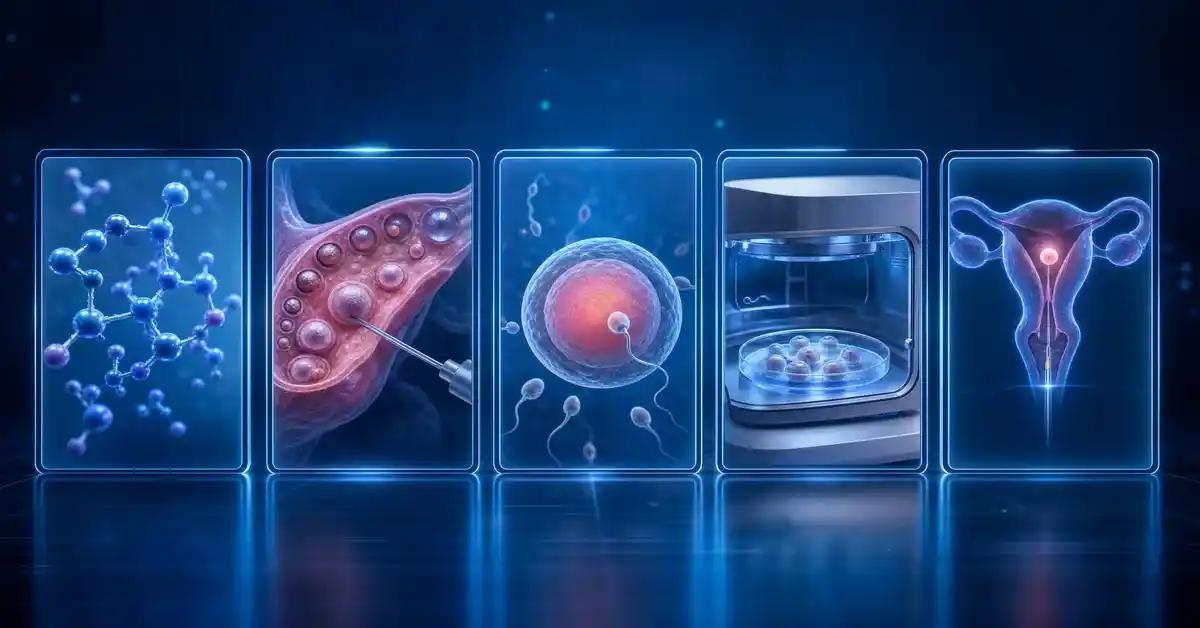
IVF Process Step by Step: From Ovarian Stimulation to Embryo Transfer

Manar Hegazy

Majd Eddin Khaled
IVF can initially feel like a long sequence of injections, scans, laboratory procedures, and appointments.
Once the process is understood in order, however, the treatment pathway becomes much easier to follow.
A typical IVF cycle begins with evaluation and treatment planning, followed by ovarian stimulation, monitoring, final oocyte-maturation trigger, egg retrieval, fertilization, embryo culture, and then either embryo transfer or cryopreservation.
Some patients complete a fresh embryo transfer during the same cycle. Others freeze embryos and return for frozen embryo transfer later.
Fertiliv helps international patients organize testing, records, monitoring, travel, and communication with the medical team throughout these stages.
Before IVF: Evaluation and Treatment Planning
IVF does not usually begin with the first injection.
The medical team first reviews the couple's fertility history and relevant testing.
Evaluation may include:
Female age
Duration of infertility
Ovarian reserve
Menstrual history
Antral follicle count
Uterine and tubal findings
Semen analysis
Previous fertility treatment
Surgical history
Previous pregnancies or losses
Current medical conditions and medication
The purpose is not only to confirm whether IVF is appropriate.
It also helps determine the stimulation strategy, initial medication dose, fertilization method, monitoring plan, and whether fresh transfer or a freeze-all strategy may be considered.
Read also: IVF Tests Before Traveling to Turkey
Ovarian Stimulation
In a natural menstrual cycle, usually only a limited number of follicles progress toward ovulation.
During IVF, medications are used to stimulate the ovaries so that several follicles can develop during the same treatment cycle.
The objective is not simply to produce the highest possible number of oocytes.
Treatment aims for an appropriate response while maintaining patient safety.
Current European Society of Human Reproduction and Embryology guidance emphasizes individualized ovarian stimulation based on ovarian reserve, expected response, safety, and treatment circumstances.
Medication type, dose, and duration can therefore differ substantially between patients.
Read also: IVF Medications in Turkey: Are They Included in IVF Cost and How Much Do They Cost?
Monitoring During Stimulation
Ultrasound monitoring is used to follow follicular development.
The team may evaluate:
Number of follicles
Follicle sizes
Response of each ovary
Relevant ovarian findings
Endometrium when clinically useful
Selected hormone measurements may also be requested depending on the protocol.
Not every patient needs a full hormone panel at every monitoring visit.
Based on the findings, the physician may continue the same medication dose, adjust it, add medication to prevent premature ovulation, or schedule another scan.
This is one reason the exact egg-retrieval date cannot always be predicted at the start of treatment.
Final Oocyte-Maturation Trigger
When the follicular cohort reaches an appropriate stage, the physician schedules the final trigger.
This step helps prepare the oocytes for retrieval.
Trigger timing is particularly important because egg retrieval is scheduled in relation to it.
Current European Society of Human Reproduction and Embryology guidance describes trigger timing as a multifactorial decision involving follicle development, stimulation duration, hormonal information when relevant, embryo-transfer strategy, previous treatment experience, and other clinical factors.
Patients should receive clear instructions containing the medication, dose, date, and exact administration time.
Egg Retrieval
Egg retrieval is performed after the final trigger at the time specified by the treatment team.
The procedure is generally completed with appropriate anesthesia or sedation.
Using ultrasound guidance, follicular fluid is aspirated and examined for oocytes.
It is important to understand:
the number of follicles is not always equal to the number of oocytes retrieved
and
the number of retrieved oocytes is not always equal to the number of mature oocytes.
After retrieval, the patient is monitored and receives recovery and medication instructions.
What Happens to the Oocytes?
The embryology laboratory evaluates retrieved oocytes, including their maturity.
Mature oocytes can then undergo fertilization.
There are two principal approaches.
Conventional IVF
Prepared sperm and oocytes are placed together under laboratory conditions and fertilization is allowed to occur without direct sperm injection.
ICSI
One selected sperm is injected directly into a mature oocyte.
ICSI is not automatically better for every patient. The decision depends on male-factor findings, previous fertilization history, sperm source, and other laboratory and clinical factors.
Read also: IVF vs ICSI: What Is the Difference and When Is Each Treatment Used?
Fertilization Assessment
Not every retrieved oocyte becomes an embryo.
The pathway may progressively narrow:
developing follicles → retrieved oocytes → mature oocytes → fertilized oocytes → developing embryos
This reduction can occur naturally at each stage.
Successful retrieval therefore does not guarantee that every egg will fertilize or form a transferable embryo.
Embryo Culture
After fertilization, embryos are followed during the next several days.
Embryologists assess development according to the stage and laboratory criteria.
Some embryos may progress to the blastocyst stage around Day 5 or Day 6, while others may stop developing earlier.
The European Society of Human Reproduction and Embryology's 2026 laboratory recommendations emphasize patient identification and traceability throughout sperm preparation, oocyte handling, fertilization assessment, embryo culture, cryopreservation, and embryo transfer.
What Happens If PGT Is Planned?
When preimplantation genetic testing is part of the treatment plan, suitable embryos may undergo biopsy and then be frozen while results are pending.
The pathway may therefore become:
retrieval → fertilization → embryo culture → biopsy → embryo freezing → genetic result → later transfer preparation
PGT is not necessary for every IVF patient.
Its role depends on the type of genetic testing, age, medical history, and treatment goals.
Read also: IVF With PGT-A and PGT-M in Istanbul
Fresh Transfer or Freeze-All?
After embryo development, treatment may follow different pathways.
Fresh Embryo Transfer
When medically appropriate, an embryo may be transferred during the same treatment cycle.
The decision considers ovarian response, endometrial conditions, embryo development, risk of ovarian hyperstimulation syndrome, and other clinical factors.
Freeze-All
In other cycles, embryos are cryopreserved and transfer is postponed.
This may be considered when:
PGT is planned
Ovarian hyperstimulation risk is high
The endometrium is not appropriate for transfer
Another clinical issue requires postponement
Uterine treatment is needed first
Current ovarian-stimulation guidance supports freeze-all in selected patients at risk of late ovarian hyperstimulation syndrome.
Embryo Transfer
Embryo transfer is different from egg retrieval and usually does not require general anesthesia.
A thin catheter is passed through the cervix and the embryo is placed inside the uterine cavity.
Ultrasound guidance may be used.
The number of embryos transferred should also be considered carefully because transferring more embryos increases the risk of multiple pregnancy.
European Society of Human Reproduction and Embryology guidance includes specific recommendations intended to support safer embryo-transfer decisions.

Is Bed Rest Required After Transfer?
Prolonged bed rest has not been shown to improve IVF outcomes.
Most patients can resume normal light daily activity according to their medical instructions.
Walking or using the bathroom does not cause an embryo to fall out of the uterus.
What If All Embryos Are Frozen?
The patient can often return home after retrieval and the required follow-up.
A separate frozen embryo-transfer cycle is then planned later.
Endometrial preparation may follow a natural or programmed approach depending on the treatment plan.
Read also: Traveling to Turkey for Frozen Embryo Transfer: Timeline, Steps, and Preparation
Medication After Embryo Transfer
Medication may continue after transfer to support the endometrium.
The exact regimen depends on the transfer protocol.
Patients should not stop medication because of mild cramps, spotting, lack of pregnancy symptoms, or an early home pregnancy test.
Medication should continue according to the treatment team's instructions.
Pregnancy Testing
The treatment team specifies when a blood pregnancy test should be performed after embryo transfer.
When positive, the next steps may include repeat testing, continued medication, and later ultrasound.
A negative result should also be reviewed in context rather than assuming that the exact reason for failure is immediately known.
How Long Does IVF Take?
There is no single timeline for every patient.
A simplified pathway is:
| Stage | What Happens? |
|---|---|
| Before cycle | Evaluation, testing, and treatment planning |
| Cycle start | Ovarian stimulation begins |
| During stimulation | Medication and ultrasound monitoring |
| End of stimulation | Final trigger |
| Next stage | Egg retrieval |
| Following days | Fertilization and embryo culture |
| Later | Fresh transfer or embryo freezing |
| After transfer | Medication support and pregnancy testing |
When embryos are frozen, embryo transfer becomes a separate treatment stage and may require a later visit for international patients.
Why Can the Plan Change During IVF?
The original treatment strategy is based on the information available before stimulation.
It may change because of:
Higher or lower ovarian response than expected
Different follicular growth
Ovarian hyperstimulation risk
Oocyte number
Embryo development
Endometrial findings
Genetic results
Another clinical development
A change in strategy does not necessarily mean the original plan was incorrect.
Some decisions can only be made after seeing the patient's actual response.
Before IVF: Checklist
Make sure you understand:
Which tests are required?
What stimulation protocol is expected?
Which medications will be used?
When is the first monitoring appointment?
Will conventional IVF or ICSI be used?
Is PGT being considered?
Is fresh transfer or freeze-all the initial plan?
What happens if stimulation takes longer?
How long might international travel require?
Who should you contact if medication changes?
When do travel dates become more predictable?
Conclusion
The core IVF pathway can be summarized as:
evaluation → ovarian stimulation → monitoring → final trigger → egg retrieval → fertilization → embryo culture → transfer or freezing → pregnancy test
However, the details are individualized.
One patient may need longer stimulation, another may require ICSI rather than conventional IVF, and another may freeze all embryos instead of having a fresh transfer.
IVF is therefore not one fixed protocol applied identically to every patient.
Fertiliv helps international patients organize testing, records, travel, monitoring, and communication with the medical team throughout the treatment journey.
Frequently Asked Questions: IVF Process Step by Step: From Ovarian Stimulation to Embryo Transfer
What Is the First Step of IVF?
IVF begins with medical evaluation, review of both partners' fertility information, and treatment planning before stimulation medication starts.
How Long Does Ovarian Stimulation Last?
It varies according to individual ovarian response and cannot be fixed for every patient.
When Is Egg Retrieval Scheduled?
The date becomes clearer after follicular monitoring and the final trigger is scheduled.
Does Every Retrieved Egg Become an Embryo?
No. Some oocytes may be immature, some may not fertilize, and some embryos may stop developing.
How Are IVF and ICSI Different During the Process?
Most treatment stages are similar. The principal difference is how fertilization is performed in the laboratory.
Is Embryo Transfer Always Performed in the Same Cycle?
No. Embryos may be frozen and transferred during a later cycle when medically appropriate.
Is Bed Rest Necessary After Embryo Transfer?
Prolonged bed rest has not been shown to improve routine embryo-transfer outcomes.
When Will I Know If IVF Worked?
The treatment team schedules a blood pregnancy test after embryo transfer according to the treatment protocol.