
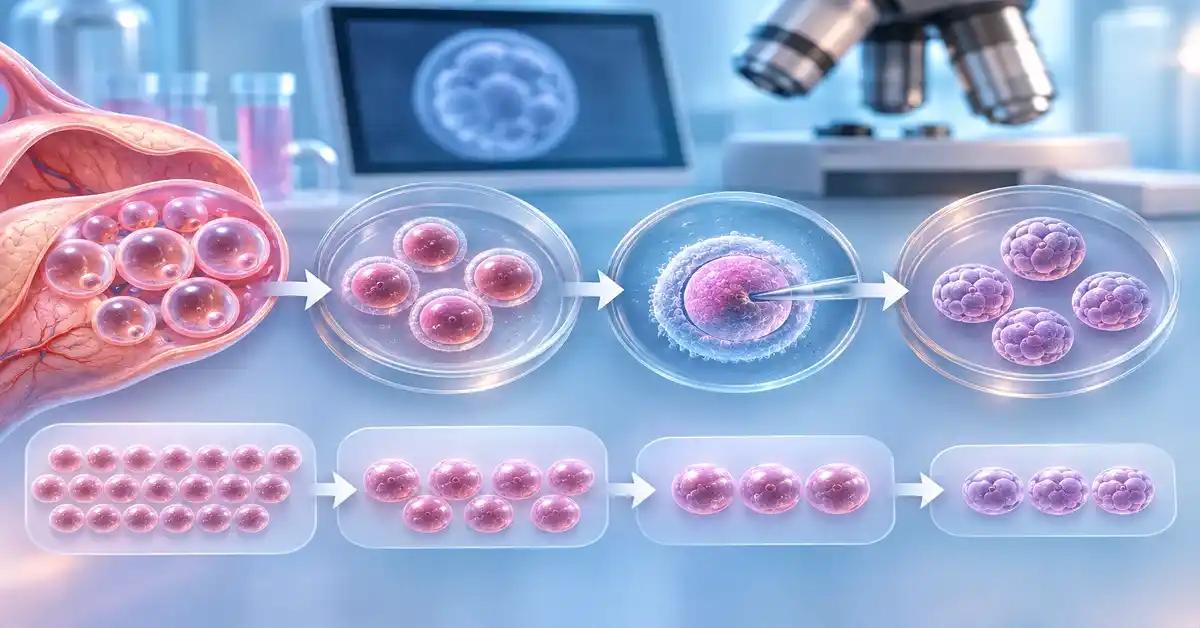
Why Do Egg and Embryo Numbers Drop During IVF? From Follicles to Embryos Step by Step

Manar Hegazy

Majd Eddin Khaled
One of the most confusing parts of IVF is watching the numbers decrease at each stage.
A patient may have 15 follicles on ultrasound, retrieve 11 oocytes, learn that nine are mature, have six fertilize normally, and eventually end up with fewer embryos reaching the blastocyst stage.
This often leads to the question:
Where did the other eggs go, and does this mean the IVF cycle is failing?
Not necessarily.
IVF involves several biological stages, and not every follicle, oocyte, fertilized egg, or embryo progresses to the next stage.
The pathway may look like:
follicles → retrieved oocytes → mature oocytes → fertilized oocytes → developing embryos → blastocysts → embryos suitable for transfer or freezing
Some reduction along this pathway is expected.
Fertiliv helps patients understand the complete cycle rather than judging treatment by one number alone.
A Follicle Is Not the Same as an Egg
This is the first important distinction.
A follicle is a fluid-filled structure within the ovary.
The oocyte develops inside it.
During ultrasound, clinicians can see and measure follicles, but they cannot directly see an egg inside every follicle.
Therefore, 12 follicles on ultrasound do not guarantee that 12 oocytes will be retrieved.
Some follicles may:
Be too small
Contain an immature oocyte
Not yield a recoverable oocyte
Develop differently from the larger follicular cohort
The first numerical decrease can therefore occur between:
follicles seen on ultrasound → oocytes actually retrieved
Read also: IVF Process Step by Step: From Ovarian Stimulation to Embryo Transfer
Why Doesn't Every Follicle Yield an Oocyte?
Follicles do not develop identically.
Some are smaller, some lag behind, and some may not yield an oocyte during aspiration.
The follicle count before retrieval is therefore an estimate of ovarian response, not a guaranteed egg count.
Final Trigger Timing Matters
Before retrieval, the final oocyte-maturation trigger is given according to the physician's instructions.
Current European Society of Human Reproduction and Embryology guidance describes trigger timing as a multifactorial decision involving follicle development, stimulation duration, overall ovarian response, and other clinical considerations.
Even with appropriate timing, not every retrieved oocyte will necessarily be mature.
Retrieved Oocytes Are Not All Mature
After retrieval, the embryology laboratory evaluates the oocytes.
Some may be mature and ready for fertilization, while others may still be immature.
For example:
10 oocytes retrieved
may become:
8 mature oocytes suitable for fertilization
This reduction does not automatically indicate that something went wrong.
Follicles grow at different rates, and follicle size only predicts maturity imperfectly.
Can Immature Oocytes Mature Later?
In selected laboratory settings, immature oocytes may undergo further maturation, and in vitro maturation is also a distinct assisted-reproduction technique.
However, this is not equivalent to routinely obtaining mature oocytes during a standard stimulated IVF cycle.
When reviewing a cycle, distinguish between:
total retrieved oocytes
and
mature oocytes available for fertilization
Why Doesn't Every Mature Egg Fertilize?
Maturity does not guarantee fertilization.
Fertilization is a complex biological interaction between the sperm and oocyte.
It may be attempted through conventional IVF or ICSI.
Even with ICSI, where a sperm is directly injected into the oocyte, normal fertilization cannot be guaranteed for every mature egg.
Read also: IVF vs ICSI: What Is the Difference and When Is Each Treatment Used?
Does ICSI Prevent Attrition?
No.
ICSI addresses one stage: getting a sperm into the oocyte.
It does not guarantee that:
Every retrieved oocyte is mature
Every injected oocyte fertilizes normally
Every embryo continues developing
Every embryo becomes a blastocyst
Every blastocyst is suitable for transfer
Every transferred embryo implants
The American Society for Reproductive Medicine states that routine ICSI for low oocyte yield or diminished ovarian reserve does not improve fertilization or live-birth outcomes when another ICSI indication is absent.
What Happens After Fertilization?
A normally fertilized oocyte begins a new developmental stage.
During the following days, embryos divide and continue developing.
Some progress normally, while others may slow, show abnormal development, or stop dividing.
Therefore:
seven fertilized oocytes
do not necessarily become:
seven transferable embryos.

Why Do Some Embryos Stop Developing?
Embryo arrest can reflect several interacting factors, including:
Female age
Oocyte biology
Sperm-related factors
Chromosomal abnormalities
Embryonic developmental competence
Laboratory factors
It is not always possible to identify exactly why an individual embryo stopped developing.
Embryo attrition during culture does not automatically indicate laboratory error.
Why Do Numbers Fall Between Day 3 and Day 5?
Embryos continue dividing during the first several days after fertilization.
Some embryos reach cleavage stages but do not progress to the blastocyst stage around Day 5 or Day 6.
For example:
6 normally fertilized oocytes
may become:
5 developing embryos on Day 3
and later:
2 or 3 blastocysts
The exact pattern varies significantly among patients and cycles.
There is no single guaranteed conversion rate.
Is Losing Embryos Before Day 5 a Bad Sign?
Not automatically.
Progression to blastocyst is itself a developmental selection process.
The result needs to be interpreted alongside:
Female age
Mature oocyte number
Fertilization rate
Starting embryo number
Previous treatment history
Embryo development
One blastocyst may be a meaningful outcome in a patient who began with only a few mature oocytes.
What Does a “Good Embryo” Mean?
Embryologists assess embryos according to developmental stage and morphological features.
At the blastocyst stage, assessment may include expansion, the inner cell mass, and trophectoderm appearance.
However, morphology does not provide complete genetic information.
An embryo with favorable morphology can still have chromosomal abnormalities, while morphology alone cannot determine whether implantation will occur.
Is Every Blastocyst Frozen or Transferred?
Not necessarily.
The laboratory determines whether an embryo meets criteria for transfer or cryopreservation.
Depending on development, an embryo may:
Be selected for transfer
Be frozen
Continue in culture for further observation
Not meet laboratory criteria for preservation
This can create another numerical reduction between blastocysts and embryos ultimately available for treatment.
What Happens When PGT Is Added?
Preimplantation genetic testing adds another selection stage.
The pathway may become:
oocytes → fertilization → embryos → blastocysts suitable for biopsy → genetic testing → embryos suitable according to the result
The number can therefore fall again after genetic results.
This is particularly relevant as embryo chromosome abnormalities become more common with increasing female age.
PGT does not improve or repair an embryo; it provides information about tested embryos according to the type of test.
Read also: IVF With PGT-A and PGT-M in Istanbul
A Practical Example of IVF Attrition
Imagine monitoring shows:
14 follicles
Retrieval yields:
11 oocytes
Of those:
9 are mature
Normal fertilization occurs in:
7
By Day 3:
6 embryos continue developing
And eventually:
3 reach the blastocyst stage
It would be incorrect to say that “11 embryos were lost from the original 14.”
The original 14 were follicles—not embryos.
Each stage represents a different biological threshold.
Why Can't You Compare Your Numbers With Another Patient?
Two patients with the same follicle count can have very different outcomes.
The number alone does not capture:
Age
Oocyte maturity
Sperm factors
Fertilization
Embryo competence
Previous history
One patient may retrieve six eggs and produce two blastocysts.
Another may retrieve 15 and also produce two blastocysts.
A larger starting number does not guarantee a proportionally larger final embryo number.
Should You Worry About a Low Egg Number?
A lower egg number reduces the number of opportunities within that cycle, but it does not mean pregnancy is impossible.
The important questions are:
How many were mature?
How many fertilized?
How did embryos develop?
What is the patient's age?
What happened in previous cycles?
Using increasingly high stimulation doses also cannot always transform a low ovarian reserve into a high egg yield.
Current European Society of Human Reproduction and Embryology guidance focuses on individualized ovarian stimulation and an appropriate balance between response and safety.
Is a High Egg Number Always Better?
Not necessarily.
More oocytes may create more opportunities, but an excessive ovarian response can increase ovarian hyperstimulation risk in susceptible patients.
The goal is an appropriate and safe response—not the highest possible number at any cost.
What If Oocyte Maturity Is Unusually Low?
If many oocytes are retrieved but relatively few are mature, the team may review:
Trigger timing
Follicle sizes at trigger
Follicular synchrony
Previous cycle response
Other cycle-specific factors
One cycle should still be interpreted in its full clinical context.
What If Fertilization Is Low?
When mature oocyte number is reasonable but fertilization is unexpectedly poor, the team should review:
Whether conventional IVF or ICSI was used
Semen findings
Previous fertilization history
Whether the pattern has repeated
If conventional IVF produced total or markedly reduced fertilization, ICSI may be considered in a subsequent cycle.
Read also: ICSI After Failed IVF: When Can It Be a Better Option?
What If Fertilization Was Good but Few Embryos Reached Blastocyst?
That is a different problem.
When mature oocytes fertilized normally but embryo development later declined, simply changing the fertilization method may not solve the issue.
The team may review female age, oocyte factors, sperm factors, embryo-development records, previous cycles, and laboratory findings.
Which Numbers Should You Ask for After IVF?
Do not ask only:
“How many embryos do I have?”
Ask for the whole sequence:
| Stage | Useful Number |
|---|---|
| Before retrieval | Follicle count and sizes |
| Retrieval | Oocytes retrieved |
| Laboratory assessment | Mature oocytes |
| Fertilization | Normally fertilized oocytes |
| Early culture | Embryos continuing development |
| Day 5/6 | Blastocysts |
| Cryopreservation | Embryos frozen |
| PGT, if performed | Embryos biopsied and results according to test type |
This sequence gives a much more meaningful picture of the cycle.
How Can the Team Identify Where Unexpected Attrition Occurred?
The cycle can be reviewed by stage.
Large Difference Between Follicles and Retrieved Oocytes
Review stimulation and retrieval.
Many Retrieved Oocytes but Few Mature
Review maturation and trigger-related factors.
Good Mature Oocyte Number but Low Fertilization
Review fertilization method and male factors.
Good Fertilization but Embryo Arrest
Review oocyte, sperm, embryo-development, and laboratory factors.
Good Embryos but No Pregnancy
Attention shifts toward transfer and implantation rather than automatically blaming fertilization.
Does Only One Embryo Mean the Cycle Failed?
No.
One embryo suitable for transfer or freezing represents a treatment opportunity.
At the same time, one embryo cannot guarantee pregnancy.
Its meaning should be interpreted according to age, embryo characteristics, and treatment history.
Can Attrition Be Improved in the Next Cycle?
Sometimes, depending on where the largest reduction occurred.
A future cycle may involve discussion of:
Stimulation strategy
Trigger planning
Fertilization method
Male-factor assessment
Previous laboratory findings
But not all attrition is preventable.
Some reflects the normal biology of oocytes and embryos.
A realistic goal is not:
100% mature oocytes + 100% fertilization + 100% blastocyst development
because this is not how human reproduction works.
Do Not Treat Internet Percentages as Rules
Patients often encounter fixed percentages online for maturity, fertilization, or blastocyst development.
These may be useful as broad statistical references in some populations, but they are not rules for an individual cycle.
Results vary according to age, diagnosis, oocyte number, sperm factors, treatment method, previous history, and laboratory conditions.
Your cycle should therefore be interpreted against your own clinical context.
IVF Attrition Checklist
Ask:
How many follicles were present before retrieval?
What were their sizes?
How many oocytes were retrieved?
How many were mature?
Which fertilization method was used?
How many fertilized normally?
How did embryos develop each day?
How many reached blastocyst?
How many were frozen?
Are any embryos still being observed?
If PGT was performed, how many were biopsied?
At which stage did the largest decrease occur?
Was that pattern expected in my case?
Does anything need to change in another cycle?
Conclusion
A decrease from many follicles to fewer embryos does not automatically mean that IVF failed.
The process includes several biological stages:
follicles → oocytes → mature oocytes → fertilization → developing embryos → blastocysts → embryos available for transfer or freezing
Numbers can decrease at every stage.
The important question is not simply how many were lost.
It is:
At which stage did the reduction occur, and was it expected for this patient's situation?
Do not judge the entire cycle from the first ultrasound follicle count or from the egg-retrieval number alone.
The complete embryology pathway tells the real story.
Fertiliv helps patients organize stimulation, retrieval, fertilization, and embryo-development reports and coordinate a complete review of the IVF cycle.
Frequently Asked Questions: Why Do Egg and Embryo Numbers Drop During IVF? From Follicles to Embryos Step by Step
Does the Number of Follicles Equal the Number of Eggs?
No. A follicle can contain an oocyte, but not every follicle necessarily yields a retrievable egg.
Why Are Some Retrieved Eggs Immature?
Follicles develop at different rates, so oocytes may be at different maturity stages at retrieval.
Should Every Mature Egg Fertilize?
No. Even with ICSI, normal fertilization cannot be guaranteed for every mature oocyte.
Why Do Some Embryos Stop Before Day 5?
Embryo development can be influenced by oocyte, sperm, chromosomal, developmental, and laboratory factors.
Is It Normal for Embryo Numbers to Fall Between Day 3 and Day 5?
Yes, this can occur because not every developing embryo reaches the blastocyst stage.
Does Having Only One Embryo Mean the IVF Cycle Failed?
No. One transferable or freezable embryo still represents a treatment opportunity.
Does a Low Egg Number Mean ICSI Should Automatically Be Used?
No. Low oocyte yield alone is not a proven reason for routine ICSI.
What Information Should I Request From the Embryology Laboratory?
Ask for retrieved oocytes, mature oocytes, fertilization results, daily embryo development, blastocyst number, and embryos frozen or biopsied.