
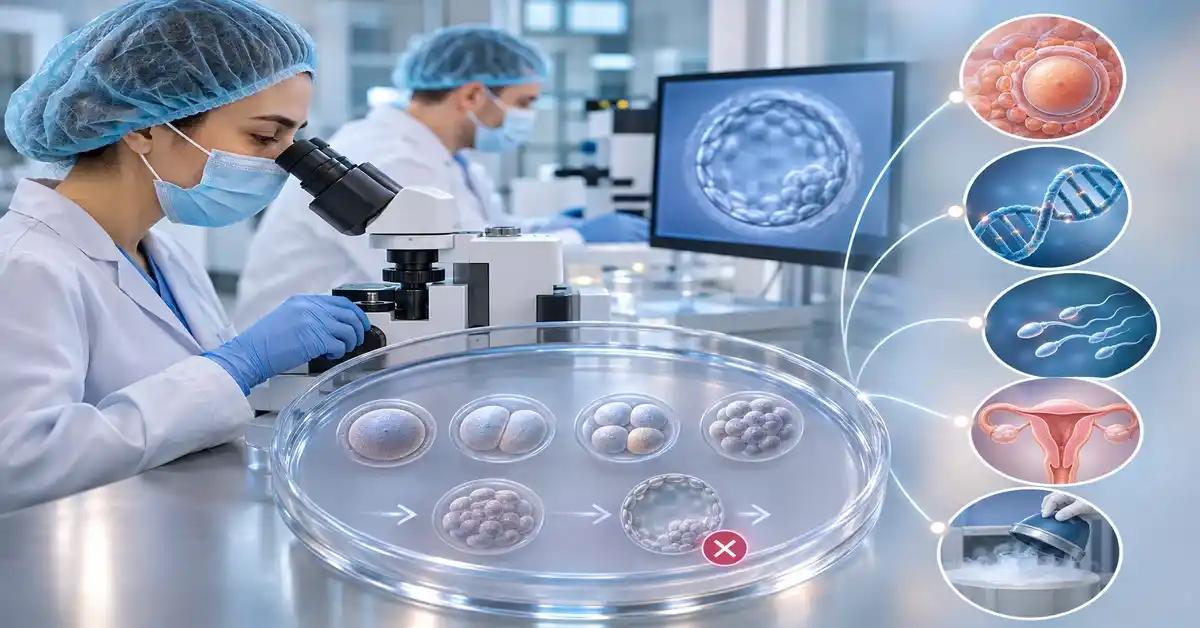
Why Don’t Some Embryos Reach Day 5? Causes of Embryo Arrest Before the Blastocyst Stage

Manar Hegazy

Majd Eddin Khaled
After fertilization, patients may feel that one of the most difficult stages of IVF has already been completed.
Then the embryology report may say:
“Six eggs fertilized, but only one embryo reached the blastocyst stage.”
Or:
“Fertilization occurred, but no embryo reached Day 5.”
This raises an important question:
If fertilization was successful, why did embryo development stop afterward?
Fertilization is only the beginning of embryonic development.
Over the next several days, the embryo must undergo carefully coordinated cell divisions and biological changes before reaching the blastocyst stage, usually around Day 5 or Day 6.
Not every fertilized oocyte completes this process.
Fertiliv helps patients organize fertilization and embryo-development reports and coordinate review of where developmental attrition occurred before planning another treatment cycle.
What Happens Between Day 1 and Day 5?
After normal fertilization, the embryo begins dividing.
A simplified pathway is:
Day 1: fertilization assessment
followed by:
Days 2–3: cleavage-stage divisions
then:
around Day 4: morula formation
and:
Day 5 or 6: blastocyst development
A blastocyst is a more advanced developmental stage in which cells begin organizing into distinct populations.
However, progression from one stage to the next is not guaranteed.
Read also: Why Do Egg and Embryo Numbers Drop During IVF? From Follicles to Embryos Step by Step
What Does Embryo Arrest Mean?
Embryo arrest means that development or cell division stops progressing appropriately.
This may happen:
During early cleavage
Around Days 2–3
At the morula stage
Before full blastocyst formation
Some embryos may temporarily develop slowly and later continue, while others undergo permanent developmental arrest.
Laboratories therefore interpret embryo development over time rather than from one isolated observation.
Is It Normal That Not Every Embryo Reaches Day 5?
Yes.
Not every fertilized oocyte is expected to become a blastocyst.
A cycle might show:
8 normally fertilized oocytes → 6 developing embryos on Day 3 → 3 blastocysts
Another patient may have very different numbers.
There is no guaranteed blastocyst conversion rate for every individual.
Good Fertilization Does Not Guarantee Blastocyst Development
Normal fertilization confirms that the egg and sperm successfully initiated embryo formation.
It does not guarantee that the embryo can complete all later developmental steps.
Therefore, a patient can have:
good fertilization
but later:
poor blastocyst development.
This is different from fertilization failure.
If fertilization itself was poor, the review focuses on the fertilization stage.
If fertilization was good and embryos later arrested, the relevant clinical question is different.
Read also: ICSI After Failed IVF: When Can It Be a Better Option?
What Role Does the Oocyte Play?
The oocyte contributes much more than half of the embryo's DNA.
During early development, the embryo relies heavily on cellular and molecular components supplied by the oocyte.
Factors involving the oocyte can therefore influence whether development continues normally.
Relevant considerations can include:
Female age
Oocyte maturity
Chromosome segregation
Cellular function
The oocyte's ability to support early embryonic development
This is one reason maternal age influences embryo development as well as egg number.
Why Does Female Age Matter?
The frequency of chromosomal abnormalities in oocytes and embryos increases with female age.
Some chromosomal errors can impair continued embryo development.
However, this relationship should not be oversimplified.
Not every embryo that arrests is chromosomally abnormal, and some chromosomally abnormal embryos can still reach blastocyst.
Age therefore changes probability, but it does not identify the cause of arrest in a specific embryo.
Are Chromosomal Abnormalities an Important Cause?
Recent research supports chromosome-segregation errors as an important contributor to preimplantation embryo arrest.
Both meiotic errors originating from the gametes and mitotic errors occurring after fertilization may interfere with continued development.
However, embryo arrest is biologically complex.
Other potential contributors include:
Genetic variants
Abnormal gene regulation
Mitochondrial function
Problems during embryonic genome activation
Other cellular processes that remain incompletely understood
For this reason, the exact cause cannot usually be assigned to each individual arrested embryo.
What Is Embryonic Genome Activation?
During the earliest stage, embryo development relies heavily on material stored in the oocyte.
The embryo then begins activating its own genome.
This transition is critical.
Disruption of the processes involved in embryonic genome activation can interfere with cleavage and continued development.
An embryo may therefore fertilize normally and divide initially before later arresting.
Can Sperm Contribute to Embryo Arrest?
Yes, paternal factors can contribute, although they are not the only explanation.
Sperm contributes paternal DNA and other biological factors involved after fertilization.
Relevant problems may include abnormalities involving:
Chromosomes
DNA integrity
Genetic factors
Early post-fertilization processes
However, embryo arrest should not automatically be attributed to sperm.
The semen analysis, fertilization method, previous cycles, and exact timing of embryo arrest all matter.
Does Sperm DNA Fragmentation Explain Embryo Arrest?
Not in every case.
Additional male-factor testing may be discussed in selected patients, especially when there is a significant male factor or a repeated pattern.
But no single sperm test explains all cases of poor blastocyst development.
Testing should ideally answer a specific clinical question and have the potential to change management.

Can the Laboratory Be Responsible?
Embryo culture requires tightly controlled laboratory conditions.
These include:
Temperature
Gas concentrations
Culture media
Incubator stability
Handling procedures
Quality-management systems
ESHRE's 2026 good-practice recommendations emphasize quality control across embryo culture and other IVF laboratory procedures.
However, arrested embryos do not automatically indicate laboratory error.
Even in high-quality laboratories, some embryos will not reach blastocyst because embryo biology itself is a major determinant of development.
When Should Laboratory Factors Be Reviewed?
Laboratory conditions may deserve closer review when there is:
An unusual repeated pattern
Very poor results across several cycles despite otherwise favorable findings
A documented laboratory incident
A marked unexplained difference compared with previous development
A single cycle with some arrested embryos is not sufficient evidence of a laboratory problem.
What If Embryos Looked Good on Day 3 but Stopped Later?
Day-3 morphology provides useful but incomplete information.
Embryologists can evaluate features such as:
Cell number
Fragmentation
Symmetry
Other morphological characteristics
However, morphology cannot perfectly predict which cleavage-stage embryo will become a viable blastocyst.
ASRM has noted that reliable criteria capable of identifying every early embryo destined to form a viable blastocyst have not been established.
Is Day 5 the Absolute Deadline?
No.
Some embryos reach blastocyst on Day 5, while others do so on Day 6.
Some laboratories may continue selected slow-developing embryos to Day 7.
Therefore:
“Not a blastocyst on Day 5”
does not always mean:
“the embryo has permanently stopped.”
The laboratory evaluates whether development is still progressing.
Can Day-6 Blastocysts Still Be Used?
Yes.
Suitable Day-6 blastocysts can be cryopreserved or used according to the treatment plan.
ASRM's PGT-A committee opinion notes that euploid blastocysts developing on Day 6 can still result in live birth.
Developmental speed is one factor among several considered by the laboratory.
What About Day-7 Blastocysts?
Some centers continue selected embryos through Day 7.
This can identify additional blastocysts in patients who otherwise may have none available on Days 5 or 6.
Day-7 embryos may have different expected outcomes from faster-developing embryos, so their use depends on laboratory assessment and the treatment strategy.
Why Can't Embryos Simply Be Cultured Indefinitely?
An embryo that has permanently stopped dividing cannot simply be kept in culture indefinitely with the expectation that normal development will restart.
Embryologists assess progression within established biological timeframes.
They monitor:
Cleavage
Compaction
Morula formation
Blastocoel development
Blastocyst structure
Embryos that no longer demonstrate appropriate progression are classified according to laboratory policy.
Is Day-5 Transfer Always Better Than Day-3 Transfer?
No single answer applies to every patient.
Blastocyst culture provides more information about which embryos continue developing and can help embryo selection.
However, extended culture also increases the possibility that a patient may have no embryo available for transfer.
ASRM has reported that blastocyst transfer can offer advantages in good-prognosis patients, while also acknowledging a higher risk of having no embryo to transfer after extended culture.
The choice between cleavage-stage and blastocyst transfer therefore depends on the clinical and embryology context.
Why Might Day-3 Transfer Be Discussed When Embryo Numbers Are Low?
When only a small number of embryos are available, the team may discuss whether continued culture provides enough benefit to justify the possibility of having no blastocyst available later.
However, transferring an embryo earlier does not necessarily rescue an embryo that is biologically destined to arrest.
It is also impossible to state that an embryo that arrested in culture would definitely have continued developing if transferred on Day 3.
This is why the decision needs to be individualized.
Does Switching From IVF to ICSI Prevent Embryo Arrest?
Not necessarily.
ICSI primarily changes the fertilization stage by injecting a sperm directly into the oocyte.
If fertilization already occurred normally and the embryos later arrested, ICSI alone does not automatically correct that developmental problem.
The stage at which the problem occurred should therefore be identified before changing fertilization strategy.
Read also: IVF vs ICSI: What Is the Difference and When Is Each Treatment Used?
Does PGT Prevent Embryos From Arresting Before Day 5?
No.
Embryo genetic testing is performed on embryos that have already reached a stage appropriate for biopsy.
If an embryo arrests before blastocyst development, PGT cannot make it continue growing.
PGT also does not repair chromosomal abnormalities; it provides information about tested embryos.
Read also: IVF With PGT-A and PGT-M in Istanbul
Does No Blastocyst in One Cycle Mean a Severe Problem?
Not necessarily.
A single cycle can have an unexpectedly poor outcome.
The starting embryo number also matters.
For example:
2 fertilized embryos → 0 blastocysts
has a different statistical context from:
10 fertilized embryos → 0 blastocysts.
The result should therefore be interpreted relative to how many embryos entered culture.
When Does Repeated Embryo Arrest Become More Significant?
A repeated pattern such as:
good fertilization → several cleavage-stage embryos → most or all arrest before blastocyst
deserves more detailed review.
This may include:
Female age
Oocyte maturity and yield
Fertilization method
Semen findings
Previous embryo development
Timing of arrest
Embryology observations
Relevant medical or genetic history
Even after a thorough review, one definitive explanation may not always be found.
Does the Couple Need Genetic Testing?
Not automatically.
Genetic evaluation may be discussed when additional indications exist, such as:
Repeated severe embryo arrest
Relevant family history
Recurrent pregnancy loss
A known chromosome rearrangement
Other findings suggesting a genetic cause
Broad testing after a single poor cycle is not automatically appropriate for every couple.
Can Changing Stimulation Medication Prevent Embryo Arrest?
Sometimes stimulation strategy may be reviewed, especially if the previous ovarian response suggests a reason to change it.
However, no single stimulation protocol has been proven to prevent embryo arrest in all patients.
The previous cycle should be used to identify a specific problem rather than assuming that simply changing medication will solve embryo development.
Read also: How Is an IVF Treatment Plan Chosen and Why Does It Differ Between Patients?
Can Egg Quality Be Improved Before the Next Cycle?
General health optimization may be worthwhile, including:
Avoiding smoking
Managing chronic medical conditions
Maintaining appropriate nutrition
Using supplements only when medically appropriate
However, no short-term supplement or treatment can guarantee that future embryos will become high quality.
In particular, supplements cannot reverse the biological effect of maternal age on chromosome abnormalities.
What Should You Ask the Embryology Laboratory?
Do not settle for:
“The embryos stopped.”
Ask:
| Question | Why It Matters |
|---|---|
| How many mature oocytes were available? | Establishes the starting point |
| How many fertilized normally? | Separates fertilization from later development |
| What happened on Days 2 and 3? | Shows cleavage progression |
| When did development slow or stop? | Identifies the affected stage |
| Did embryos reach morula? | Shows how far development progressed |
| Were any Day-6 blastocysts formed? | Day 5 is not an absolute deadline |
| Was selected culture continued to Day 7? | Depends on laboratory policy |
| Did this pattern occur before? | Helps identify recurrence |
A Practical Example
Suppose there are:
8 mature oocytes
and:
6 fertilize normally.
On Day 3:
5 embryos are still developing.
On Day 5:
one embryo has become a blastocyst
while two others remain slower but continue developing.
It would be premature to describe the result as:
“One embryo succeeded and five failed.”
before the complete Day-6 report is available.
The numbers alone also do not prove a sperm problem or laboratory problem.
What If No Embryo Reaches Blastocyst?
A structured review becomes especially useful when a reasonable number of embryos were available initially.
Review:
Mature oocyte number
Normal fertilization number
Stage of arrest for each embryo
Whether arrest was early or late
Previous cycle history
Female age
Male-factor findings
Relevant medical or genetic factors
The next treatment plan should then target the stage at which the problem occurred.
What Can Be Changed Next Time?
There is no universal answer.
Possible discussions may include:
Adjusting stimulation when clinically justified
Reviewing final maturation
Reviewing fertilization strategy if fertilization was also abnormal
Reassessing male factors when indicated
Reviewing embryo-culture strategy
Discussing transfer timing according to embryo number and history
Ordering additional testing only when there is a clear indication
The goal is to address a defined problem rather than simply adding more procedures.
Not Every IVF Add-On Prevents Embryo Arrest
After a disappointing cycle, patients may encounter many proposed laboratory add-ons.
Before using one, ask:
What problem is this supposed to solve?
Is there evidence it improves outcomes in patients like me?
Will the result change management?
Is it established or still experimental?
More technology does not automatically mean better embryo development.
Checklist Before the Next Cycle
Review:
Oocytes retrieved
Mature oocytes
Fertilization method
Normally fertilized oocytes
Day-2 report
Day-3 report
Stage at which each embryo slowed or stopped
Day-5 and Day-6 findings
Any delayed blastocysts
Previous cycle results
Semen analysis
Female age
Specific embryology recommendations
Then ask:
What exactly are we changing next time, and why?
Conclusion
Successful fertilization does not mean every embryo will reach Day 5.
After fertilization, an embryo must complete complex cell divisions, chromosome segregation, gene activation, and cellular organization before becoming a blastocyst.
Embryo arrest can involve a complex combination of:
oocyte biology + maternal age + chromosome and genetic factors + paternal contribution + embryonic cell division + laboratory conditions
The exact cause cannot usually be determined for every individual embryo.
It is also important to remember that:
not reaching blastocyst on Day 5 does not always mean development has ended, because some embryos become blastocysts on Day 6 and, in selected laboratory settings, later.
When embryo arrest repeats across cycles, the most useful approach is to identify where development repeatedly stops rather than assuming that one new fertilization method or one add-on will solve the problem.
Fertiliv helps patients organize fertilization and embryo-development reports and coordinate review of previous treatment before planning the next IVF or ICSI cycle.
Frequently Asked Questions: Why Don’t Some Embryos Reach Day 5? Causes of Embryo Arrest Before the Blastocyst Stage
Is It Normal for Some Embryos to Stop Before Day 5?
Yes. Not every fertilized oocyte develops into a blastocyst.
Does Good Fertilization Mean Embryos Will Reach Day 5?
No. Fertilization is only one stage of embryo development.
Does Embryo Arrest Mean the Egg Is the Problem?
Not necessarily. Oocyte, sperm, chromosome, embryonic, genetic, and laboratory factors may all contribute.
Is Day 5 the Final Deadline?
No. Some embryos become blastocysts on Day 6, and selected laboratories may continue suitable embryos to Day 7.
Does ICSI Prevent Embryo Arrest?
No. ICSI assists fertilization but does not guarantee blastocyst development.
Can PGT Help an Embryo Reach Day 5?
No. PGT evaluates embryos that have already reached a stage suitable for biopsy.
Should Embryos Always Be Transferred on Day 3 If Blastocyst Development Is Poor?
No. Transfer timing depends on embryo number, development, treatment history, and laboratory strategy.
When Is Further Evaluation More Important?
When most or all embryos repeatedly arrest before blastocyst formation across more than one treatment cycle.