
Why Are No Eggs Retrieved Despite Follicles? Causes and What It Means

Manar Hegazy

Majd Eddin Khaled
An IVF cycle may appear to be progressing normally.
Several follicles grow on ultrasound, final oocyte maturation is triggered, and the patient arrives for egg retrieval.
Then the result may be unexpectedly disappointing:
“Several follicles were present, but only one egg was retrieved.”
Or, more rarely:
“The follicles were aspirated, but no oocytes were found.”
This raises an obvious question:
How can follicles be clearly visible on ultrasound but produce few or no eggs at retrieval?
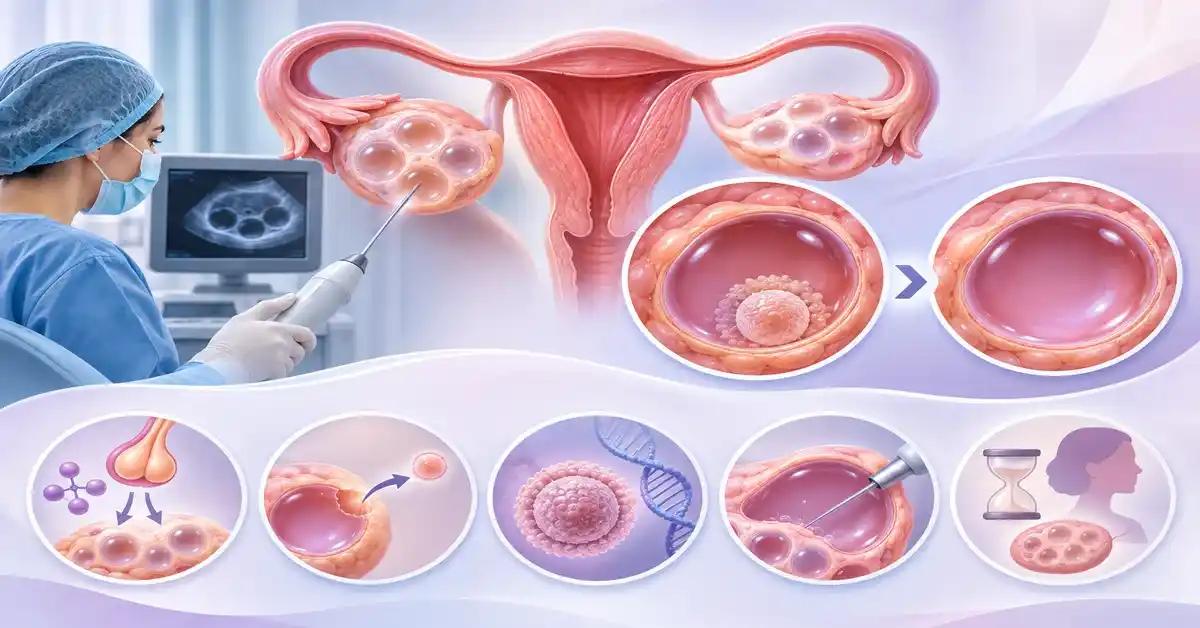
The key distinction is that a follicle is not the same thing as an oocyte.
Ultrasound visualizes the fluid-filled follicle. It cannot directly confirm the presence, maturity, or retrievability of the oocyte inside it.
Some difference between follicle count and retrieved oocyte count can therefore occur normally.
However, obtaining no oocytes despite several apparently appropriate follicles is different and deserves a structured review of final maturation, trigger administration, timing, premature ovulation, retrieval findings, and other possible explanations.
Fertiliv helps patients organize stimulation, trigger, retrieval, and embryology records and coordinate review before another treatment cycle.
A Follicle Is Not an Egg
During ovarian stimulation, ultrasound measures follicles.
A follicle is a fluid-filled ovarian structure containing the developing oocyte.
Ultrasound cannot directly confirm:
Whether each follicle contains a retrievable oocyte
Whether the oocyte detached appropriately before retrieval
Whether the oocyte reached maturity
Whether it will be identified in the aspirated follicular fluid
A scan showing:
10 follicles
may therefore result in:
7 or 8 retrieved oocytes.
This does not automatically mean something went wrong.
Read also: Why Do Egg and Embryo Numbers Drop During IVF? From Follicles to Embryos Step by Step
Why Doesn't Every Follicle Yield an Oocyte?
Follicles do not develop identically.
Some may be smaller or less advanced than others.
An oocyte may also not be recovered from every aspirated follicle.
A limited difference between follicle number and oocyte yield therefore needs to be distinguished from:
complete failure to retrieve any oocyte despite multiple apparently suitable follicles.
The latter is much less common.
What Happens During Egg Retrieval?
During oocyte retrieval, an ultrasound-guided needle aspirates fluid from ovarian follicles.
The follicular fluid is passed to the embryology laboratory, where staff search for oocytes.
The procedure therefore depends on close coordination between:
the physician aspirating the follicles
and
the embryologist examining the follicular fluid.
ESHRE good-practice guidance recommends communication between the clinical and laboratory teams during retrieval, particularly when oocyte recovery is unexpectedly poor.
Read also: IVF Process Step by Step: From Ovarian Stimulation to Embryo Transfer
Why Is the Final Maturation Trigger Important?
Before retrieval, medication is given at a specific time to initiate final oocyte maturation.
Depending on the protocol, this may involve hCG, a GnRH agonist, or another individualized strategy.
The trigger helps the oocyte complete critical final maturation processes before retrieval.
The choice depends on ovarian response, treatment protocol, OHSS risk, previous treatment, and other clinical factors.
Can Trigger Timing Affect Oocyte Retrieval?
Yes.
The interval between final maturation and retrieval is carefully planned.
If insufficient time has passed, the oocyte may not have completed the processes required for optimal recovery.
At the other extreme, premature ovulation before retrieval can also interfere with oocyte recovery.
However, retrieving fewer oocytes than follicles does not by itself prove that timing was incorrect.
Trigger timing becomes particularly important when the oocyte yield is dramatically lower than expected or zero.
What If the Trigger Was Not Administered Correctly?
When no oocytes are recovered despite several suitable follicles, one of the first issues to review is trigger administration.
The team may confirm:
The correct medication
The correct dose
The exact administration time
The route and technique
ESHRE good-practice guidance recommends checking adequate hCG exposure when no oocytes are recovered after an hCG-triggered cycle.
This does not mean every case is caused by a trigger problem, but it is an important explanation to exclude.
Can the Body Respond Inadequately to the Trigger?
Rarely, the biological response to final maturation may be inadequate.
This is particularly relevant in some GnRH-agonist trigger cycles, because successful triggering relies on the patient's own pituitary hormone response.
Evaluation depends on the protocol used.
An unexpectedly low oocyte yield therefore needs to be interpreted in relation to the exact trigger strategy.
Can Premature Ovulation Occur Before Retrieval?
Rarely, yes.
IVF medication is designed to prevent spontaneous ovulation before planned retrieval, but premature ovulation can occasionally occur.
Assessment may include:
Ultrasound appearance
Changes in follicular structures
Pelvic fluid
Hormonal findings when appropriate
Medication timing
Premature ovulation should not automatically be assumed whenever an oocyte is missing from a follicle.
What Is Empty Follicle Syndrome?
Empty follicle syndrome, or EFS, is a term used for the rare situation in which no oocytes are recovered despite apparently appropriate follicular development and follicle aspiration.
The term needs to be used carefully.
Not every unexpectedly low retrieval is EFS.
Other explanations should first be considered, including:
Trigger administration
Trigger timing
Retrieval timing
Premature ovulation
Actual number of appropriately developed follicles
Retrieval-related factors
EFS is therefore better viewed as a diagnosis made after other explanations have been considered.
“Genuine” vs Trigger-Related Empty Follicle Syndrome
Historically, EFS has sometimes been divided into two broad categories.
Trigger-Related or “False” EFS
The expected exposure to the final maturation signal may have been inadequate because of administration, absorption, timing, or biological response.
EFS Despite Apparently Adequate Trigger Exposure
This is much rarer and potentially more biologically complex.
Recent research has also explored genetic causes in selected recurrent oocyte and early-embryo competence disorders, including rare empty-follicle phenotypes.
That does not mean broad genetic testing is appropriate after one abnormal retrieval.

Is Empty Follicle Syndrome Common?
No.
When strict diagnostic criteria are used, it appears to be uncommon.
A 2024 retrospective study involving more than 14,000 patients identified EFS in only a small proportion of patients.
Therefore, a patient should not be labelled with EFS simply because fewer eggs were retrieved than follicles were seen.
Few Eggs Does Not Mean Empty Follicle Syndrome
For example:
8 follicles → 4 oocytes retrieved
is not empty follicle syndrome.
The yield may deserve review if it was much lower than expected, but EFS generally refers to failure to recover oocytes despite apparently suitable follicular development and aspiration.
This distinction avoids unnecessary alarm.
Does Diminished Ovarian Reserve Cause This?
Diminished ovarian reserve can reduce the number of follicles and oocytes expected from a cycle.
When only one or two suitable follicles are present, failure to recover an oocyte from one follicle has a much larger impact on the final result.
However, diminished ovarian reserve and empty follicle syndrome are not the same condition.
Read also: Can ICSI Be Done With Only One Egg?
No Oocyte vs Immature Oocyte
These outcomes are different.
No Oocyte Recovered
The follicular fluid was examined, but no oocyte was identified.
Immature Oocyte Recovered
An oocyte was found, but it had not reached the developmental stage normally required for fertilization or ICSI.
Therefore:
no egg
is not the same as:
an immature egg.
Read also: Why Are Some Eggs Immature After Retrieval? Causes and Impact on IVF and ICSI
Does Follicle Size Guarantee an Egg?
No.
Follicle size helps estimate development, but the oocyte itself is not visible on ultrasound.
ESHRE guidance emphasizes that trigger decisions are multifactorial and should take into account the follicular cohort, stimulation duration, hormonal information when needed, previous cycles, and other clinical factors.
There is no follicle diameter that guarantees oocyte recovery.
Does Repeated Follicular Flushing Help?
It may appear logical that repeatedly rinsing a follicle could recover an oocyte missed during initial aspiration.
However, evidence has not demonstrated a clear benefit from routine follicular flushing in standard retrievals.
ESHRE good-practice recommendations therefore do not support assuming that more flushing automatically improves oocyte yield.
What Happens If No Eggs Are Found During Retrieval?
Management depends on the exact circumstances.
During retrieval, the team may reassess:
How many follicles have been aspirated
Whether granulosa or cumulus cells are present
Trigger administration and timing
Whether other follicles remain
The timing of retrieval
In highly selected circumstances, a rescue strategy may be considered if inadequate final maturation is strongly suspected.
Such decisions are highly time-sensitive and protocol-dependent.
Can Another Trigger Be Given and Retrieval Repeated?
Selected rescue strategies have been described when trigger failure or inadequate final maturation is suspected.
A 2024 retrospective study of carefully selected EFS cases reported favorable outcomes when a second retrieval was delayed by several hours in certain patients.
However, this should not be interpreted as a universal recommendation.
The study was retrospective, and rescue decisions depend on the trigger used, hormone response, follicular findings, and timing.
Can the Cycle Be Converted to Another Treatment?
There is no single routine alternative.
Without an oocyte, IVF or ICSI cannot proceed in that cycle.
Some alternative rescue approaches have historically been explored in selected cases, but they may have very low success and are not routine substitutes for oocyte retrieval.
The priority is determining why no oocyte was obtained.
Does No Oocyte Mean the Ovary Contains No Eggs?
No.
One retrieval reflects one ovarian-stimulation cycle.
Failure to recover oocytes from that cycle does not prove that the ovaries contain no future oocytes or that another cycle cannot succeed.
Recent follow-up studies of EFS patients have shown that some subsequently achieved oocyte retrieval and live birth.
One cycle therefore does not define future fertility.
Will It Happen Again?
It may recur, but it does not necessarily do so.
If the explanation involved:
Trigger administration
Trigger timing
An inadequate hormonal response
A cycle-specific event
the next cycle may differ after the treatment plan is adjusted.
Repeated failure despite apparently adequate triggering deserves deeper evaluation.
What Should Be Reviewed Before the Next Cycle?
A structured review is useful.
Before Retrieval
Follicle number
Follicle sizes
Stimulation duration
Hormone results when relevant
Final Trigger
Medication
Dose
Administration time
Administration technique
Retrieval Timing
Trigger-to-retrieval interval
Evidence suggesting premature ovulation
During Retrieval
Follicles aspirated
Technical observations
Presence of follicular cells
Laboratory
Oocytes identified
Whether any were immature
Findings within follicular fluid
This provides far more information than simply documenting “no eggs retrieved.”
Should the Trigger Be Changed Next Time?
Possibly, when the previous findings suggest a problem involving final maturation.
The physician may review:
Trigger type
Timing
Dose
Whether a different maturation strategy is justified
However, a more complex trigger strategy is not automatically necessary simply because oocyte yield was lower than follicle count.
The change should address a specific suspected problem.
Read also: How Is an IVF Treatment Plan Chosen and Why Does It Differ Between Patients?
Should the Stimulation Dose Be Increased?
Not automatically.
If several follicles developed appropriately but oocyte recovery was poor, simply increasing gonadotropin dose may not address the underlying issue.
Higher stimulation doses do not guarantee:
An oocyte in every follicle
A better final maturation response
Better oocyte recovery
The affected stage should be identified before treatment is changed.
What If Only One or Two Follicles Were Present?
When very few follicles are available, ending retrieval without an oocyte is more plausible simply because there were few opportunities initially.
For example:
2 suitable follicles → no oocyte
has a different context from:
12 apparently mature follicles → no oocytes.
The second result is considerably more unusual and warrants more detailed evaluation.
Should the Cycle Have Been Cancelled Before Retrieval?
Not necessarily.
Ultrasound cannot see the oocyte itself, so it may be impossible to know in advance that aspiration will yield no egg.
When very few follicles develop, the physician and patient may discuss whether retrieval is worthwhile.
That is different from having several apparently suitable follicles and unexpectedly recovering no oocytes.
Read also: When Is an IVF Cycle Cancelled Before Egg Retrieval? Causes and What Happens Next
Could There Be a Genetic Cause?
Genetic investigation is not usually the first step after one cycle.
However, newer research has identified rare genetic variants associated with specific oocyte maturation, retrieval, and early embryo competence disorders.
Genetic evaluation may become more relevant when there is:
Repeated complete failure to recover oocytes
A very unusual recurrent pattern
Other repeated oocyte-maturation defects
Additional clinical indications
One abnormal retrieval alone does not automatically justify extensive genetic testing.
Practical Example: Lower Oocyte Yield
Suppose monitoring showed:
9 follicles
and retrieval produced:
5 oocytes.
This is not EFS.
If four of those five are mature, fertilization can proceed.
There was attrition between follicle count and oocyte yield, but not complete absence of oocytes.
Practical Example: No Oocytes Retrieved
Suppose monitoring showed:
10 apparently appropriate follicles
and the follicles were aspirated, but the laboratory found no oocyte.
This calls for immediate structured review.
Important questions include:
Was the trigger given?
When was it given?
Which medication was used?
Was the expected hormonal response present?
Is premature ovulation suspected?
Were the follicles genuinely appropriate?
What was observed during retrieval?
A single diagnosis should not be assigned before these questions are considered.
Questions to Ask After an Unexpectedly Poor Retrieval
Ask:
How many follicles were present before retrieval?
What were their sizes?
How many were actually aspirated?
How many oocytes were recovered?
Were any immature?
Which final maturation trigger was used?
At what exact time was it administered?
At what time was retrieval performed?
Was the trigger response considered adequate?
Was there any evidence of premature ovulation?
Was a rescue strategy considered?
Does the team consider this cycle-specific or recurrent?
What exactly will change next time, and why?
Records to Keep
Keep copies of:
Final ultrasound before trigger
Follicle measurements
Stimulation schedule
Trigger medication and dose
Trigger administration time
Retrieval time
Procedure report
Embryology report
Relevant hormone results
These details are much more useful for another review than simply recording:
“No eggs were retrieved.”
Can a Future Cycle Still Succeed?
Yes.
Failure to retrieve oocytes in one cycle does not guarantee recurrence.
A 2024 study using strict EFS criteria found that some patients later achieved successful oocyte retrieval and live birth.
Repeated episodes deserve more extensive review, but a single episode should not be interpreted as proof that future IVF cannot succeed.
Conclusion
Seeing follicles on ultrasound does not guarantee one oocyte from every follicle because:
a follicle is not the oocyte itself.
Some difference between follicle count and retrieved oocyte number can occur during IVF.
However, when the oocyte yield is dramatically below expectations—and especially when no oocyte is found despite multiple apparently suitable follicles—the cycle should be reviewed carefully.
Important areas include:
follicular development + final maturation trigger + trigger timing + retrieval timing + premature ovulation + retrieval findings + laboratory findings
The term empty follicle syndrome should not be applied to every low-yield retrieval.
Most importantly, one cycle without oocytes does not mean the ovaries are permanently empty or that another cycle cannot succeed.
The goal is to understand what happened and determine whether anything can reasonably be modified before another attempt.
Fertiliv helps patients organize stimulation, trigger, retrieval, and laboratory records and coordinate review before planning another IVF or ICSI cycle.
Frequently Asked Questions: Why Are No Eggs Retrieved Despite Follicles? Causes and What It Means
Does Every Follicle Contain a Retrievable Egg?
No. Ultrasound shows the follicle but cannot confirm that every follicle will yield an oocyte.
Is It Normal to Retrieve Fewer Eggs Than the Number of Follicles?
Yes, this can occur. Follicle count and retrieved oocyte count are not always identical.
What Is Empty Follicle Syndrome?
It is a rare situation in which no oocytes are recovered despite apparently appropriate follicles and aspiration after other explanations are considered.
Does No Oocyte Mean My Ovaries Have No Eggs?
No. One retrieval cycle does not determine future ovarian response.
Can the Trigger Injection Be the Cause?
In some cases, trigger administration, timing, or biological response may contribute and should be reviewed.
Can Premature Ovulation Happen Before Retrieval?
Rarely, yes, and it can interfere with expected oocyte recovery.
Is an Immature Egg the Same as an Empty Follicle?
No. An immature oocyte has been recovered but is not mature; with no oocyte recovery, no egg is found for assessment.
Can a Future IVF Cycle Succeed After No Oocytes Were Retrieved?
Yes. The result does not necessarily recur, and the next strategy depends on why the previous retrieval failed.