
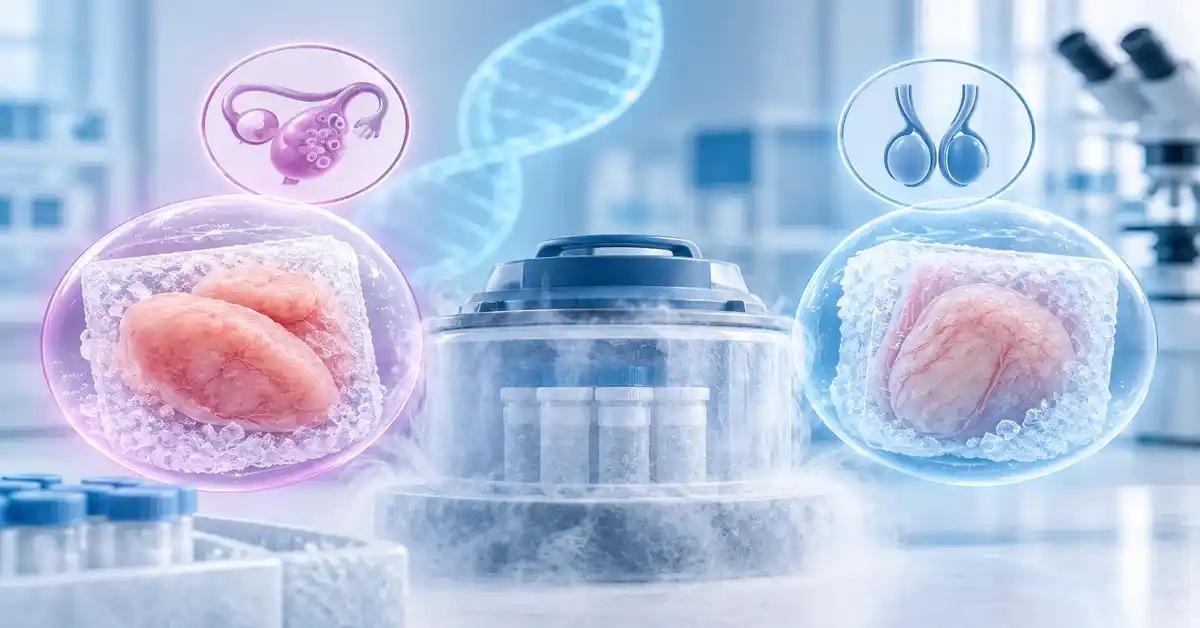
Ovarian and Testicular Tissue Freezing: Promising Techniques for Fertility Preservation

Manar Hegazy

Majd Eddin Khaled
Ovarian and testicular tissue freezing is one of the most evolving areas of fertility preservation because it aims to preserve reproductive potential at the tissue level, not only mature eggs or sperm. This is especially important when treatment must start urgently, when chemotherapy or radiation may damage reproductive organs, or when the patient is a child who has not yet reached puberty.
At Fertiliv, fertility preservation is discussed with clarity and realistic expectations. Some approaches, such as ovarian tissue freezing, are already important options in selected patients. Others, such as testicular tissue freezing before puberty, remain promising but require careful explanation because future use is still limited and cannot be presented as a guaranteed path to parenthood.
What Reproductive Tissue Freezing Means
Reproductive tissue freezing means removing and storing a small piece of ovarian or testicular tissue at very low temperatures for possible future use. The goal is to preserve early reproductive cells or tissue structures that may later help restore hormonal function, fertility potential, or reproductive cell production, depending on the tissue type and future medical advances.
Tissue freezing versus cell freezing
Egg or sperm freezing preserves mature cells that can be used more directly in assisted reproduction. Tissue freezing preserves part of the organ itself. Ovarian tissue contains early follicles that may later support ovarian function or pregnancy attempts. Prepubertal testicular tissue contains early cells that may one day help produce sperm, but this is much more technically complex.
Why tissue freezing is considered
Tissue freezing is considered when egg or sperm freezing is not possible or not enough. This may happen when cancer treatment must begin quickly, when a girl has not reached puberty, when ovarian stimulation cannot be delayed, or when a boy is too young to produce sperm. In these situations, tissue freezing may keep a future option open.
Is it suitable for everyone?
No. Tissue freezing is not suitable for every patient. The decision depends on age, diagnosis, treatment urgency, expected fertility damage, general health, safety of future tissue use, and how realistic future use may be. The choice must be individualized rather than automatic.
Read about: Egg Freezing: Modern Techniques for Future Fertility Preservation
Ovarian Tissue Freezing
Ovarian tissue freezing usually involves removing part of the ovarian cortex, where many early follicles are located. The tissue is frozen and stored. Later, after treatment and medical clearance, the tissue may be transplanted back in selected cases to support hormonal function or pregnancy attempts.
When it may be useful
Ovarian tissue freezing may be useful when there is not enough time for ovarian stimulation and egg retrieval, when the patient is prepubertal, or when treatment carries a high risk of damaging ovarian reserve. It may also be discussed when the medical situation does not allow waiting for a standard egg freezing cycle.
How the process works
The process begins with urgent medical review, including age, diagnosis, treatment plan, and ovarian reserve when possible. A small piece of ovarian tissue is usually removed through minimally invasive surgery, prepared in the laboratory, and frozen. Future use depends on recovery, medical safety, and the patient’s reproductive goals.
What to expect after transplantation
After ovarian tissue transplantation, ovarian hormonal activity may return in selected cases, and pregnancy may occur naturally or with fertility treatment. However, success is not guaranteed. Outcomes depend on age at freezing, tissue quality, amount of tissue stored, previous treatment, and future uterine and general health.
Read about: Egg Freezing for Single Women: Future Fertility Preservation Options
Testicular Tissue Freezing
Testicular tissue freezing is different from sperm freezing. In adult males, sperm freezing is usually the first and clearest option before fertility-damaging treatment. Testicular tissue freezing becomes more relevant for boys before puberty because they cannot yet produce mature sperm for storage.
Why it matters before puberty
Before puberty, boys cannot provide semen samples containing mature sperm. However, the testicular tissue contains early cells that may be important for future sperm production. Freezing a small tissue sample before treatment may preserve a biological possibility for future fertility.
Difference from sperm banking
Sperm banking stores mature sperm that can later be used in ICSI or other fertility treatments. Testicular tissue freezing stores tissue that requires future technologies before it can be used. This distinction is essential so families understand that it is not the same as sperm freezing.
Current limitations
The future potential of testicular tissue freezing is encouraging, but its use for restoring fertility in prepubertal boys is still limited and not routine. Recent progress gives hope, but broader clinical use requires more evidence, safety follow-up, and long-term outcomes.
Read about: Modern Egg Freezing Techniques: Innovations and Advanced Tips
Who May Be a Candidate?
Candidates are usually patients who face treatment with a significant risk of damaging fertility. This may include chemotherapy, pelvic or gonadal radiation, bone marrow transplantation, or surgeries that may affect the ovaries or testes. Children and adolescents require special attention because their conventional preservation options may be limited.
Girls and women before urgent treatment
Ovarian tissue freezing may be valuable for girls before puberty or women who need urgent treatment and cannot wait for egg freezing. It can preserve part of the ovarian reserve before exposure to treatment, but the decision must be coordinated with the main medical team.
Boys before puberty
For prepubertal boys, sperm freezing is not possible because sperm production has not started. Testicular tissue freezing may be discussed as a future-oriented option. Families should understand that this preserves a possibility, not a guarantee.
Non-cancer medical conditions
Fertility preservation may also be discussed for some non-cancer conditions that require treatments harmful to reproductive organs, such as certain blood, immune, or transplant-related conditions. The decision depends on the expected fertility risk and whether tissue freezing offers meaningful future value.

Benefits, Risks, and Questions Before Decision
Tissue freezing may provide hope when standard options are unavailable, but it is still a serious decision. It may involve surgery, storage costs, uncertain future use, and emotional pressure. The patient or family should receive clear counseling before moving forward.
Potential benefits
The main benefit is that tissue freezing can sometimes be done quickly and may be available before puberty. Ovarian tissue may contain many early follicles, and tissue freezing may be more time-efficient than waiting for stimulation in urgent cases.
Risks and limitations
Risks include surgery-related risks, storage responsibilities, uncertain future outcomes, and the possibility that tissue may never be used. In some cancers, future reimplantation must be evaluated very carefully because safety is central.
Questions to ask before freezing
Before deciding, patients and families should ask:
- How much fertility risk does the treatment carry?
- Is egg, embryo, or sperm freezing possible instead?
- How much time is available before treatment starts?
- How realistic is future use of the tissue?
- What are the surgical and storage risks?
- Are there any safety concerns about future transplantation?
Read about: Egg Freezing: Your Path to Preserving Fertility Between Turkey and Germany
Fertiliv’s Role in Fertility Preservation Planning
At Fertiliv, tissue freezing is approached as part of a complete fertility preservation plan, not as a simple technical procedure. The team reviews the diagnosis, age, treatment start date, fertility risk, and available options, then explains the benefits and limits clearly.
Urgent pre-treatment evaluation
When chemotherapy or radiation is planned, decisions must often be made quickly. The most important questions are whether treatment can wait briefly, whether the patient has reached puberty, whether egg or sperm freezing is possible, and whether tissue freezing is the only realistic preservation option.
Choosing the right method
Not every patient needs tissue freezing. Adult women may be better served by egg or embryo freezing when time allows. Prepubertal girls may need ovarian tissue freezing. Adult men usually bank sperm first, while prepubertal boys may require discussion of testicular tissue freezing.
Follow-up after treatment
After treatment, tissue is not used immediately without review. The patient’s health, hormone status, fertility function, safety, and reproductive goals must be reassessed. Sometimes natural fertility remains possible; in other cases, stored tissue becomes part of a future fertility plan.
Read about: Egg and Embryo Freezing: The Future of Fertility Preservation
Conclusion
Ovarian and testicular tissue freezing are promising fertility preservation approaches, especially when standard options are unavailable or urgent treatment may damage the ovaries or testes. Ovarian tissue freezing is an important option in selected patients, including prepubertal girls and women who cannot delay treatment. Testicular tissue freezing, especially before puberty, carries scientific promise but remains limited and should be explained as a future possibility rather than a guarantee.
Frequently Asked Questions: Ovarian and Testicular Tissue Freezing
Does ovarian tissue freezing guarantee pregnancy?
No. It preserves a future opportunity, not a guarantee. Success depends on age, tissue quality, amount stored, and future health.
Can girls before puberty preserve fertility?
Yes. Ovarian tissue freezing may be discussed for prepubertal girls when upcoming treatment may damage fertility.
Is testicular tissue freezing the same as sperm freezing?
No. Sperm freezing stores mature sperm. Testicular tissue freezing stores tissue that may require future technologies before use.
Is testicular tissue freezing guaranteed to work?
No. It is promising, but still limited in many uses, especially before puberty. It should be explained as a potential future option.
When should a fertility center be contacted?
As soon as fertility-damaging treatment is planned, ideally before chemotherapy, radiation, or surgery begins.