
IUI vs IVF: The Medical Difference Between Two Fertility Treatments

Manar Hegazy

Majd Eddin Khaled
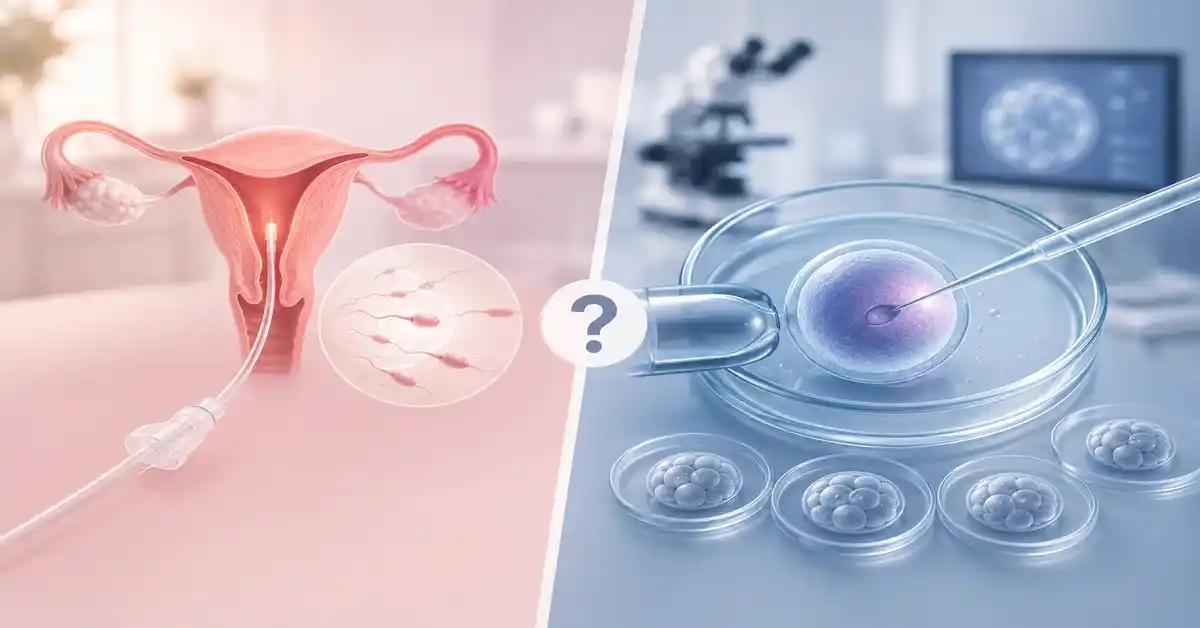
IUI and IVF are both fertility treatments, but they work in very different ways. IUI places prepared sperm directly inside the uterus near ovulation, while IVF retrieves eggs, fertilizes them in the laboratory, and transfers an embryo into the uterus. This means IUI still depends on fertilization happening inside the body, while IVF allows the laboratory to manage fertilization and embryo development more directly.
What IUI means in fertility treatment
Intrauterine insemination uses a prepared semen sample that is placed into the uterus using a thin catheter around ovulation. The goal is to improve sperm placement and timing. However, the sperm still needs to reach and fertilize the egg inside the body, so IUI requires open fallopian tubes, ovulation, and acceptable sperm quality.
What IVF means in fertility treatment
In vitro fertilization involves ovarian stimulation, egg retrieval, fertilization in the laboratory, embryo culture, and embryo transfer. Because fertilization happens outside the body, IVF can bypass several barriers that IUI cannot, including tubal blockage and some more significant sperm-related problems.
The practical difference between IUI and IVF
The practical difference is control. IUI supports the natural process inside the body, while IVF gives the fertility team more information about eggs, fertilization, embryo development, and transfer timing. This is why IUI may be reasonable for mild cases, while IVF is often more appropriate for complex fertility factors.
Medical Cases Where IUI May Be the Right Choice
IUI may be appropriate when the couple still has a realistic chance of fertilization inside the body. This usually means at least one open tube, regular or medically supported ovulation, and semen quality that remains suitable after preparation. It is often considered a lower-intervention option when the fertility problem is mild.
IUI for unexplained infertility
In unexplained infertility, the basic fertility tests may look reassuring, but pregnancy still does not happen. If the female partner is younger, ovarian reserve is acceptable, and infertility duration is not too long, IUI may be discussed before IVF. The number of attempts should be planned in advance to avoid losing time.
IUI for mild male factor infertility
IUI may help when sperm count or motility is only mildly reduced and the prepared sample still contains enough motile sperm. If sperm quality is severely reduced, IUI may not provide enough benefit because sperm still need to reach and fertilize the egg naturally.
IUI for ovulation problems that respond to treatment
When the main issue is mild ovulation dysfunction, ovulation induction with IUI may be considered if tubes are open and semen analysis is suitable. Ultrasound monitoring helps time ovulation and reduce the risk of excessive follicle development and multiple pregnancy.
Read about: Intrauterine Insemination (IUI): When Is It Recommended?
Medical Cases Where IVF Is Usually the Better Option
IVF becomes more appropriate when the chance of IUI success is low or when the fertility problem cannot be solved by placing sperm inside the uterus. In these cases, moving directly to IVF may save time and provide a clearer path, especially when age, ovarian reserve, or sperm quality creates urgency.
IVF for blocked or damaged fallopian tubes
If both fallopian tubes are blocked or severely damaged, IUI is usually not suitable because fertilization still requires the tube. IVF bypasses the tubes by fertilizing eggs in the laboratory and transferring an embryo into the uterus. This makes tubal evaluation important before choosing IUI.
IVF for severe sperm problems
When sperm count, motility, or morphology is severely abnormal, IVF with ICSI may be more suitable because the laboratory can inject a selected sperm directly into the egg. IUI cannot overcome severe fertilization barriers in the same way.
IVF for age-related fertility decline or low ovarian reserve
When female age is advanced or ovarian reserve is low, time becomes a major factor. Repeated IUI attempts may not be efficient if the chance of success is limited. IVF provides more information about egg number, fertilization, embryo development, and the best next step.

IUI and IVF Steps from Treatment Start to Pregnancy Test
Both treatments aim for pregnancy, but the journey is different. IUI is usually shorter and less complex, while IVF involves more monitoring, procedures, and laboratory work. Understanding these steps helps couples compare the emotional, financial, and medical demands of each option.
IUI treatment steps in a fertility cycle
An IUI cycle begins with evaluation, ovulation tracking, and sometimes ovulation medication. When the follicle is mature, ovulation timing is planned. The semen sample is prepared in the laboratory and placed into the uterus. The pregnancy test is usually done about two weeks later.
IVF treatment steps in a fertility cycle
An IVF cycle usually includes ovarian stimulation, ultrasound monitoring, egg retrieval, fertilization in the laboratory, embryo culture, and embryo transfer or freezing. It is more complex than IUI, but it provides more direct control over fertilization and embryo development.
Treatment duration difference between IUI and IVF
IUI is usually lighter and shorter because it does not involve egg retrieval or laboratory embryo culture. IVF requires more steps, but it may save time in cases where IUI success is unlikely. The right comparison is not only cycle length, but the time needed to reach a realistic pregnancy chance.
Read about: Complete IVF Process Guide: Master Every Step to Achieve Your Parenthood Dream
IUI vs IVF Cost and Realistic Success Rates
Cost and success rates are important, but they should be compared correctly. IUI is usually less expensive per attempt, while IVF is usually more expensive because it includes medications, egg retrieval, laboratory fertilization, embryo culture, and transfer. However, IVF often has a higher chance per cycle, especially in cases where IUI has a low probability of success.
IUI cost factors and what changes the price
IUI cost depends on consultation, ultrasound monitoring, ovulation medication, semen preparation, and any tests needed before the cycle. Couples should ask whether the quoted price includes monitoring, sperm washing, medications, and blood tests, because these details change the total cost.
IVF cost factors and why it is usually higher
IVF cost is usually higher because it includes more medical and laboratory steps. Stimulation medications, monitoring, egg retrieval, anesthesia or procedure fees, fertilization, embryo culture, transfer, and possible freezing all affect the final cost. The higher cost may be justified when IVF is much more suitable for the diagnosis.
IUI and IVF success rates by medical condition
IUI usually has a lower success rate per cycle than IVF, but it may still be reasonable in well-selected cases. IVF often gives a higher chance per cycle, especially with blocked tubes, stronger male factor, or the need for laboratory fertilization. However, there is no universal success rate for everyone; age, egg quality, sperm quality, diagnosis, and uterine health all matter.
| Comparison point | IUI | IVF |
|---|---|---|
| Fertilization location | Inside the body | In the laboratory |
| Fallopian tube requirement | Needs at least one open tube | Often bypasses tubal problems |
| Treatment complexity | Lower | Higher |
| Cost per attempt | Usually lower | Usually higher |
| Per-cycle success | Usually lower | Usually higher |
| Best fit | Mild, selected cases | More complex or urgent cases |
Choosing Between IUI and IVF Based on Your Medical Case
The best treatment is not always the simplest or the most advanced. It is the option that offers the best balance between success chance, time, cost, and medical suitability. This decision should be based on a complete couple evaluation rather than guesswork or fear of a more advanced treatment.
When starting with IUI is medically reasonable
IUI may be reasonable when the female partner is younger, tubes are open, ovulation can be monitored, semen quality is acceptable, and there are no severe fertility factors. In this situation, a limited number of planned IUI attempts may be appropriate before reassessing.
When moving directly to IVF is medically better
Moving directly to IVF may be better when tubes are blocked, sperm quality is severely reduced, female age or ovarian reserve makes time limited, previous IUI attempts failed, or fertilization and embryos need closer laboratory assessment. In these cases, IVF is not simply a bigger treatment; it is a better match for the diagnosis.
How Fertiliv helps choose between IUI and IVF
At Fertiliv, both partners are evaluated before recommending IUI or IVF. The plan considers female age, ovarian reserve, tubes, uterus, semen analysis, infertility duration, and previous attempts. The goal is to avoid unnecessary delay with IUI when IVF is clearly needed, while also avoiding advanced treatment when a simpler path is still medically reasonable.
Read about: Your Complete IVF Journey: From Start to Success
Conclusion: How to Know Whether IUI or IVF Fits Your Case
The difference between IUI and IVF is not only cost or procedure complexity. IUI may be suitable when the fertility issue is mild, the tubes are open, and semen quality is acceptable. IVF is often better when there are blocked tubes, severe sperm problems, advanced female age, low ovarian reserve, or failed simpler treatments. The right choice depends on diagnosis, time, and the couple’s full fertility picture.
Frequently Asked Questions: IUI vs IVF
Is IUI easier than IVF?
Yes. IUI is usually simpler and less invasive, but it only works well when the tubes, ovulation, and semen quality are suitable.
Is IVF always better than IUI?
No. IVF is stronger for complex cases, but IUI may be appropriate for mild cases with good medical indicators.
How many IUI attempts before IVF?
It depends on age, ovarian reserve, diagnosis, and semen quality. Repeated attempts should not continue without reassessing the plan.
Can IUI work with blocked tubes?
Usually no. IUI needs at least one open tube because fertilization still happens inside the body.
Is IVF more expensive than IUI?
Usually yes. IVF involves more medication, monitoring, egg retrieval, laboratory work, embryo culture, and embryo transfer.