
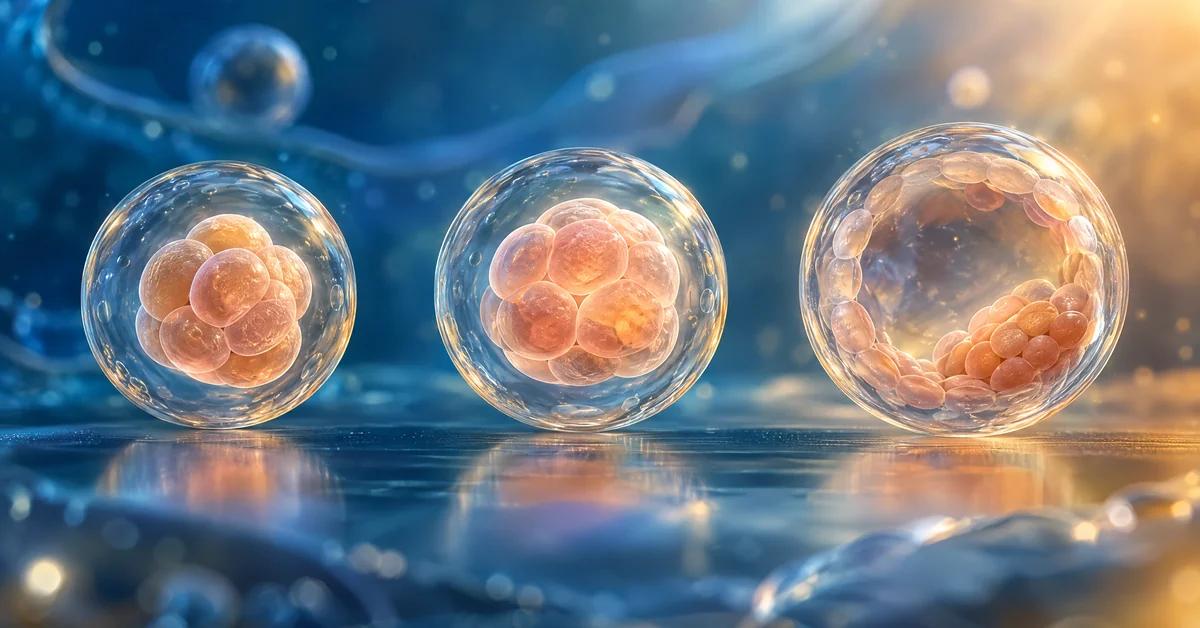
Day 5 vs Day 6 vs Day 7 Embryos: Does Slower Development Reduce IVF Success?

Manar Hegazy

Majd Eddin Khaled
After fertilization, IVF patients wait for embryos to continue developing in the laboratory.
The embryology update may eventually say:
One blastocyst developed on Day 5.
Another reached the blastocyst stage on Day 6.
A third did not become suitable until Day 7.
This raises an important question:
Is a Day 5 embryo always better, and does slower development mean a Day 6 or Day 7 embryo has a poor chance of pregnancy?
Not necessarily.
Developmental speed matters, but it is only one part of embryo assessment.
Other important factors include:
Embryo morphology.
Blastocyst grade.
PGT-A result when available.
Maternal age at egg retrieval.
Other available embryos.
Previous treatment history.
What Is a Blastocyst?
A blastocyst is an advanced stage of early embryo development.
After fertilization, the embryo undergoes repeated cell division and organization.
A normally developed blastocyst contains:
An inner cell mass, which contributes primarily to the fetus.
Trophectoderm cells, which contribute mainly to the placenta.
A fluid-filled cavity called the blastocoel.
The blastocyst stage typically begins around Day 5 or Day 6 and can occasionally be delayed until Day 7.
What Is a Day 5 Blastocyst?
A Day 5 blastocyst is an embryo that reached an appropriate blastocyst stage on the fifth day of laboratory development.
Not every Day 5 embryo is at exactly the same stage.
It may be:
An early blastocyst.
An expanded blastocyst.
A blastocyst ready for biopsy or vitrification.
What Is a Day 6 Blastocyst?
A Day 6 blastocyst needed approximately one additional day to reach the stage required for assessment, freezing or biopsy.
This is common in IVF laboratories.
A Day 6 embryo should not automatically be considered poor quality.
Many Day 6 blastocysts are frozen, transferred and result in healthy live births.
What Is a Day 7 Blastocyst?
Some embryos develop more slowly and do not become suitable blastocysts until Day 7.
Selected laboratories continue observing developing embryos through Day 7 when there is still meaningful progression.
If the embryo reaches an appropriate blastocyst stage, it may sometimes be vitrified or biopsied.
Day 7 embryos, however, require somewhat more cautious interpretation.
Why Do Embryos Develop at Different Speeds?
Even embryos created from the same couple during the same IVF cycle can develop differently.
Developmental speed may reflect a combination of:
Oocyte biology.
Sperm contribution.
Chromosome status.
Embryo-specific biology.
Timing of early cell divisions.
Laboratory culture conditions.
A mixture of Day 5 and Day 6 blastocysts in the same cycle is therefore not unusual.
Does Faster Development Always Mean a Better Embryo?
No.
Developmental speed provides useful information, but it cannot be interpreted alone.
For example, one patient may have:
A moderate-quality Day 5 embryo.
A high-quality Day 6 embryo.
PGT-A results may also differ between them.
Embryos should therefore not be ranked using development day alone.
Is Day 5 Usually Preferred Over Day 6?
When all other characteristics are extremely similar, development speed may be considered when prioritizing embryos.
However, the distinction becomes more nuanced when chromosome status is known.
Research cited by the American Society for Reproductive Medicine shows that euploid Day 6 blastocysts can have reproductive outcomes close to euploid Day 5 blastocysts.
Does a Day 6 Embryo Have a Lower Pregnancy Chance?
It is inaccurate to assign every Day 6 embryo the same reduced prognosis.
A good-quality Day 6 embryo, particularly one classified as euploid after PGT-A, can have excellent reproductive potential.
Some studies comparing euploid Day 5 and Day 6 blastocysts found no significant differences in implantation, clinical pregnancy or live birth.
Day 6 should therefore not be viewed as a failed or unusable embryo.
Is Day 6 Normal?
Yes.
Human blastocyst development commonly occurs on Day 5 or Day 6.
A blastocyst becoming suitable on Day 6 remains within the recognized developmental window.

Why Does the Laboratory Continue Culture After Day 5?
Because an embryo that has not become a blastocyst on Day 5 has not necessarily arrested.
Some embryos are still progressing and simply need more time.
Read Why Don't Some Embryos Reach Day 5? for the difference between slower development and true developmental arrest.
Does Not Reaching Day 5 Mean the Embryo Has Stopped?
No.
There is an important difference between:
an embryo that is still progressing
and
an embryo that has stopped developing.
Embryologists evaluate change over time before determining that development has arrested.
Why Not Culture Every Embryo Until Day 7?
Not every embryo continues meaningful development.
Some clearly arrest or deteriorate before Day 7.
However, embryos that are still progressing may be cultured longer according to laboratory policy.
Is a Day 7 Embryo Abnormal?
Not automatically.
Day 7 means slower blastocyst development.
It does not prove chromosome abnormality.
Euploid Day 7 blastocysts exist, and pregnancies and live births have been reported after their transfer.
However, Day 7 embryos as a group appear to have a higher rate of aneuploidy in some studies.
Are Day 7 Success Rates Lower?
On average, available evidence suggests more caution with Day 7 blastocysts.
Some studies report:
Lower euploidy rates.
Lower implantation.
Lower clinical pregnancy.
Lower live-birth rates.
compared with Day 5 or Day 6 blastocysts.
However, lower probability is not the same as no probability.
What If the Day 7 Embryo Is Euploid?
This is particularly important.
Even among euploid embryos, some studies have found lower implantation or live-birth outcomes for Day 7 blastocysts compared with Day 5 and Day 6.
Other clinical series have still reported meaningful pregnancy rates.
Therefore, Day 7 remains an additional prognostic factor rather than an automatic exclusion.
Does PGT-A Eliminate the Importance of Development Day?
Not completely.
But chromosome information changes how development speed is interpreted.
If both embryos are euploid:
Day 5 euploid.
Day 6 euploid.
their expected reproductive potential may be much closer than a patient might assume simply from the development day.
What If My Day 6 Embryo Is Euploid but My Day 5 Embryo Was Not Tested?
You cannot automatically assume the untested Day 5 embryo is better.
The Day 6 embryo has an additional piece of information: its PGT-A classification.
Selection should consider the full embryo profile.
Is a Day 5 Euploid Embryo Better Than a Day 6 Euploid Embryo?
A Day 5 embryo may be prioritized when all other characteristics are similar.
However, this does not mean a Day 6 euploid blastocyst has poor potential.
ASRM has cited studies in which implantation, clinical pregnancy and live-birth outcomes were not significantly different between euploid Day 5 and Day 6 blastocysts.
What if the Day 6 Embryo Is 4AA and the Day 5 Embryo Is 3BB?
Development day alone cannot answer the question.
The laboratory considers:
Expansion stage.
Inner cell mass.
Trophectoderm.
Development day.
PGT-A result when available.
Read IVF Embryo Grading: What Embryo Grades Mean for a detailed explanation of grades such as 4AA and 3BB.
Is a Day 6 4AA Better Than a Day 5 3BB?
There is no universal answer.
If neither embryo has been tested, morphology and developmental speed both contribute to prioritization.
If one embryo is euploid and the other is aneuploid or untested, chromosome information may substantially change the decision.
Does Embryo Grade Reveal Chromosome Status?
No.
A morphologically excellent embryo can be aneuploid.
A lower-grade embryo can be euploid.
Morphology and PGT-A answer different questions.
Can Day 7 Blastocysts Undergo PGT-A?
Yes, if they develop sufficiently for trophectoderm biopsy.
Embryo biopsy may be performed on suitable blastocysts developing on Day 5, Day 6 or Day 7.
They are commonly vitrified after biopsy while the genetic laboratory processes the sample.
Read Embryo Freezing Before Genetic Results.
Why Are Chromosome Abnormalities More Common in Some Slower Embryos?
Some research has found an association between slower blastocyst development and higher rates of aneuploidy.
However, an association does not mean every slower embryo is chromosomally abnormal.
A slow-growing embryo can still be euploid.
Development speed cannot diagnose chromosome status.
Does Day 7 Mean There Was a Problem With the Egg?
Not necessarily.
Embryo development reflects a complex interaction of many factors.
These may include:
Oocyte biology.
Sperm contribution.
Chromosomes.
Embryonic gene activation.
Cell-division dynamics.
A single slow embryo cannot reliably identify whether the cause came from the egg or sperm.
What If All My Embryos Are Day 6?
This does not mean the IVF cycle failed.
Several transferable or freezable Day 6 blastocysts can represent a good laboratory outcome.
The absence of Day 5 embryos alone should not define the cycle as poor.
What If Slow Development Happens in Several IVF Cycles?
If most embryos repeatedly develop slowly, the clinical and embryology teams can review the complete pattern, including:
Oocyte maturity.
Fertilization.
Early cleavage.
Blastocyst formation.
Sperm findings.
PGT-A results if available.
Laboratory history.
There is not always one identifiable cause.
Does ICSI Make Embryos Reach the Blastocyst Stage Faster?
No.
ICSI helps achieve fertilization by injecting a sperm directly into the oocyte.
After fertilization, embryo development depends on the biology of the embryo.
ICSI does not guarantee Day 5 blastocyst formation.
Does Day 6 Mean Poor Sperm Quality?
Not by itself.
Blastulation day cannot be used as a direct sperm-quality test.
Embryo development reflects multiple maternal, paternal and embryonic factors.
Are Day 5 and Day 6 Embryos Frozen Differently?
Both can be vitrified when suitable.
The key requirement is that the embryo reaches an appropriate blastocyst stage and quality for cryopreservation.
Day 5 and Day 6 blastocysts are routinely vitrified in modern IVF programs.
Can Day 7 Embryos Be Frozen?
Yes, selected Day 7 blastocysts can be vitrified when they meet laboratory criteria.
Their slower development is then considered when prioritizing them relative to other embryos.
Do Slow Embryos Survive Warming?
Day 6 and Day 7 embryos can survive vitrification and warming.
Cryosurvival also depends on:
Embryo quality at freezing.
Expansion stage.
Vitrification technique.
Laboratory expertise.
Development day is not the only determinant.
How Are Day 5, Day 6 and Day 7 Embryos Prioritized?
The team may consider:
PGT-A result when available.
Development day.
Blastocyst morphology.
Previous transfer history.
Post-warming appearance.
Individual clinical factors.
When several euploid embryos of similar quality are available, Day 5 or Day 6 embryos are generally prioritized before Day 7 embryos.
Is Day 5 Always First?
No.
For example:
A Day 5 embryo may have weaker morphology.
A Day 6 embryo may have excellent morphology and be euploid.
That additional information cannot be ignored simply because one embryo developed earlier.
Why Are Many Day 6 Embryos Frozen?
The embryo may become suitable after the timing for a fresh transfer has passed, or the cycle may already involve PGT-A or a freeze-all strategy.
Vitrification allows the embryo to be stored for a later FET cycle.
Does a Day 6 Embryo Need an Extra Day of Progesterone During FET?
Patients should not adjust progesterone timing based on the Day 5 or Day 6 label themselves.
FET timing depends on:
Embryo stage.
Natural or programmed cycle.
Ovulation timing.
Progesterone start.
Clinic protocol.
Follow the specific transfer plan provided by the treatment team.
Does Day 7 Require a Different FET Protocol?
Development day may be considered by some programs when planning transfer timing, but practices are not sufficiently uniform for patients to calculate their own progesterone schedule.
The clinic should determine transfer timing.
Is Development Day More Important Than Maternal Age?
No.
Maternal age at egg retrieval remains strongly associated with the probability of embryo aneuploidy.
Development day and maternal age provide different information.
Is a Day 7 Embryo Useless if I Have a Day 5 Embryo?
No.
The Day 5 embryo may receive priority, but the Day 7 embryo can remain an additional reproductive option if suitable for freezing or classified as euploid.
Should Day 7 Embryos Be Discarded?
Not simply because they developed on Day 7.
If a blastocyst reaches appropriate quality, the laboratory and medical team should assess its value alongside the rest of the embryo cohort.
What If Day 7 Is My Only Blastocyst?
The perspective changes significantly.
A suitable Day 7 blastocyst may provide a pregnancy opportunity for a patient who otherwise has no transferable blastocyst.
A lower statistical probability is not the same as zero chance.
What If My Only Embryo Is a Euploid Day 7 Blastocyst?
Transfer can be discussed.
Live births have occurred after euploid Day 7 transfer.
Patients should simply understand that some studies suggest lower reproductive outcomes compared with euploid Day 5 and Day 6 blastocysts.
What Information Should I Request From My Embryology Report?
Useful information includes:
Number of oocytes retrieved.
Number mature.
Number fertilized.
Number reaching blastocyst.
Day each blastocyst developed.
Grade of each blastocyst.
Which embryos were vitrified.
PGT result when performed.
This gives a much clearer picture than simply asking how many embryos exist.
A Practical Example
Imagine a report showing:
Day 5: 4AA
Day 6: 4AB
Day 6: 4BB
Day 7: 5BB
This information helps prioritize embryos but does not predict pregnancy with certainty.
Now imagine PGT-A shows:
Day 5 4AA: aneuploid.
Day 6 4AB: euploid.
Day 6 4BB: euploid.
Day 7 5BB: euploid.
The interpretation changes significantly because chromosome status adds an important layer of information.
What If We Did Not Perform PGT-A?
That is common.
PGT-A is not required for every IVF patient.
Without genetic testing, embryo prioritization may consider:
Maternal age.
Morphology.
Development speed.
Previous treatment outcomes.
Post-warming development.
These factors estimate probability; they do not guarantee outcome.
Should PGT-A Be Performed Just Because an Embryo Is Day 6?
No.
Day 6 development alone is not sufficient reason to perform PGT-A.
Testing should be considered according to the patient's complete clinical situation.
Is Day 7 Alone a Reason for PGT-A?
Not automatically.
Although higher aneuploidy rates have been reported among Day 7 embryos in some studies, PGT-A decisions should still consider age, embryo number and the expected value of testing.
Which Matters More: Development Day or Embryo Grade?
They describe different things.
Development day reflects speed.
Embryo grade describes blastocyst expansion and morphology.
PGT-A provides information about chromosome copy number in the tested sample.
The best assessment integrates these different layers.
Does a Slow Blastocyst Mean the Baby Will Grow Slowly?
No.
Day 6 or Day 7 describes how quickly the embryo reached the blastocyst stage in the laboratory.
It does not mean a resulting fetus or child will continue to develop more slowly during pregnancy.
What Should I Understand if the Laboratory Says, “We Are Waiting Until Day 6”?
Do not automatically interpret this as bad news.
It may simply mean the embryo is still developing and needs more time before it can be classified, biopsied or frozen.
What If They Say They Will Wait Until Day 7?
This usually means one or more embryos are still showing progression but have not yet reached the required blastocyst stage.
Extended observation may give those embryos a final opportunity to become usable blastocysts.
How Does Fertiliv Review Day 5, Day 6 and Day 7 Embryos?
The embryo is not evaluated by development day alone.
The complete picture includes:
Oocyte number and maturity.
Fertilization.
Embryo development.
Blastulation day.
Morphology.
PGT results when available.
Cryopreserved embryos.
Planned transfer strategy.
The purpose is to choose an embryo using all available information rather than a single number on the report.
Conclusion
The difference between Day 5, Day 6 and Day 7 embryos primarily reflects how quickly the embryo reached the blastocyst stage.
Day 5 embryos developed earlier.
Day 6 embryos needed approximately another day.
Day 7 embryos developed more slowly.
Development speed matters, but it does not determine pregnancy potential by itself.
Day 6 blastocysts, particularly euploid Day 6 embryos, can have very good reproductive potential and should not be considered poor embryos merely because they developed one day later.
Day 7 blastocysts appear to have higher aneuploidy rates and lower reproductive outcomes on average in some studies, but they can still be transferable and have resulted in live births.
Embryo selection should therefore consider:
Development day.
Morphology.
PGT-A when available.
Maternal age at retrieval.
Other available embryos.
Clinical history.
A Day 5, Day 6 or Day 7 label should never be interpreted in isolation.
Frequently Asked Questions
Is a Day 6 Embryo Weaker Than a Day 5 Embryo?
Not necessarily. Day 6 blastocysts can have good morphology, and euploid Day 6 embryos can achieve strong implantation and live-birth outcomes.
Can a Day 7 Embryo Be Transferred?
Yes, if it reaches an appropriate blastocyst stage. Average outcomes may be lower than for Day 5 or Day 6 embryos, but successful pregnancies and live births do occur.
Which Matters More: Blastocyst Day or Embryo Grade?
Both provide different information. PGT-A adds another important layer when available, so embryo selection should not be based on one factor alone.
Does a Day 6 Embryo Need PGT-A Because It Developed Slowly?
No. Day 6 development alone is not an indication for PGT-A. Testing decisions should be based on the complete clinical situation.
Can My Only Day 7 Embryo Still Result in Pregnancy?
Yes. Day 7 blastocysts, including euploid Day 7 embryos, have resulted in pregnancies and live births, although average success may be lower than with earlier-developing blastocysts.