
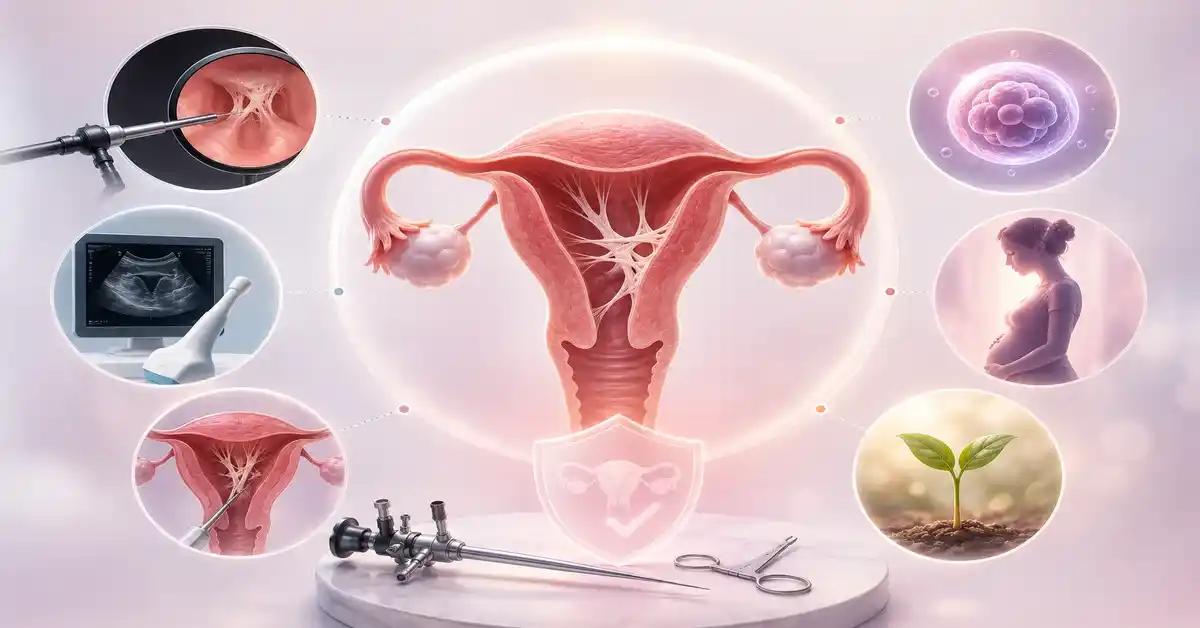
Asherman Syndrome: Diagnosis, Treatment, and Its Impact on Fertility

Manar Hegazy

Majd Eddin Khaled
Asherman syndrome is a condition in which scar tissue or adhesions form inside the uterine cavity or cervix. These adhesions may change the shape of the uterine cavity, reduce the healthy endometrial surface, or interfere with menstrual flow, implantation, and pregnancy continuation. It is often linked with trauma to the endometrium after uterine procedures, especially procedures performed after pregnancy, miscarriage, or retained pregnancy tissue.
At Fertiliv in Istanbul, Asherman syndrome is evaluated as an important uterine factor in infertility, recurrent pregnancy loss, thin endometrium, and implantation failure. Some cases are mild and treatable with a limited hysteroscopic procedure, while severe cases may require advanced surgical experience, careful follow-up, and a personalized fertility plan.
What Asherman Syndrome Is
Asherman syndrome refers to intrauterine adhesions that cause parts of the uterine walls to stick together. The adhesions may be thin and limited, or dense and extensive, sometimes narrowing or partially closing the uterine cavity. The clinical importance depends on severity, location, and how much functional endometrium remains.
Adhesions versus Asherman syndrome
Not every small adhesion means severe Asherman syndrome. Some adhesions are limited and may not cause major symptoms, while others distort the uterine cavity and affect menstruation, fertility, or pregnancy. This is why the doctor evaluates the patient’s symptoms, uterine history, imaging, and hysteroscopic findings together.
Why it affects fertility
Pregnancy requires a normal uterine cavity and a healthy endometrium that can receive and nourish an embryo. If adhesions reduce the cavity, block areas of the endometrium, or create scarring, implantation may become more difficult and miscarriage risk may increase. This makes Asherman syndrome a uterine-factor cause of infertility.
Is it permanent?
Asherman syndrome is not always permanent. Mild and moderate adhesions may improve after hysteroscopic adhesiolysis. However, severe disease can be harder to treat because the endometrium may be damaged and adhesions can reform. Outcome depends on disease severity, surgical technique, remaining healthy endometrium, and follow-up.
Causes and Symptoms
Asherman syndrome often develops after injury to the basal layer of the endometrium, especially when the uterus was recently pregnant. Common associations include dilation and curettage, treatment of retained products of conception, postpartum complications, uterine surgery, and infection.
Uterine procedures after pregnancy
A common pattern is menstrual change or infertility after a uterine procedure for miscarriage, retained tissue, or postpartum bleeding. This does not mean every DC causes adhesions, but when the period becomes very light or absent afterward, evaluation is important. The recently pregnant uterus appears more sensitive to endometrial trauma, which helps explain this association.
Common symptoms
Symptoms may include very light periods, absent periods, pelvic pain around the expected time of menstruation, infertility, or recurrent pregnancy loss. Some women have few symptoms, and the condition is suspected only after delayed conception or repeated failed embryo transfer.
When to suspect it
Asherman syndrome should be considered when a woman has a history of uterine surgery or DC followed by menstrual reduction, infertility, recurrent miscarriage, thin endometrium, or implantation failure. It is especially important to evaluate the uterine cavity before repeated embryo transfer attempts when the history is suggestive.
Read about: Premature Ovarian Insufficiency (POF): Causes, Symptoms, And Medically Available Fertility Options
Diagnosis of Asherman Syndrome
Diagnosis requires assessment of the uterine cavity. Standard ultrasound may show indirect clues, but it may miss smaller adhesions. Tests that outline or directly visualize the cavity are more useful, and hysteroscopy is considered the most definitive method because it can diagnose and treat intrauterine pathology.
Ultrasound and saline sonography
Transvaginal ultrasound may assess endometrial thickness and uterine structure, but it cannot always detect adhesions. Saline infusion sonography can improve cavity visualization by showing irregularities or areas where the cavity does not expand normally. It is useful as a screening tool when Asherman syndrome is suspected.
HSG
Hysterosalpingography can show filling defects, cavity narrowing, or an abnormal cavity outline. It can also assess tubal patency when infertility is being evaluated. However, it cannot directly remove adhesions and may not define their nature as precisely as hysteroscopy.
Hysteroscopy
Hysteroscopy allows direct visualization of the uterine cavity and adhesion severity. It may also allow treatment during the same procedure. ASRM describes hysteroscopy as the definitive method for diagnosis and treatment of intrauterine pathologies, and ACOG notes that hysteroscopy can be used to remove adhesions caused by infection or previous surgery.

Treatment Options
Treatment depends on adhesion severity, symptoms, fertility goals, and the condition of the endometrium. The main treatment is hysteroscopic adhesiolysis, followed by strategies to reduce recurrence and support endometrial recovery when appropriate.
Hysteroscopic adhesiolysis
During hysteroscopic adhesiolysis, the surgeon carefully separates scar tissue to restore the uterine cavity as much as safely possible. Mild adhesions may be easier to treat, while severe adhesions require more caution because the endometrium may be thin and the risk of uterine perforation or recurrence may be higher.
Reducing recurrence
After surgery, the doctor may consider measures to keep the cavity open and support endometrial healing. These may include temporary intrauterine barriers or hormone support depending on the case. There is no single approach for all patients, so the plan should be based on surgical findings and fertility goals.
Follow-up after treatment
Follow-up may include ultrasound, saline sonography, or second-look hysteroscopy to confirm that the cavity remains open. This is especially important before pregnancy attempts or embryo transfer in moderate or severe cases.
| Treatment stage | Main goal | Clinical decision |
|---|---|---|
| Before hysteroscopy | Confirm suspicion and severity | Imaging, timing, surgical need |
| During hysteroscopy | Restore cavity safely | Technique and extent of adhesiolysis |
| After surgery | Reduce recurrence | Barrier, hormones, follow-up timing |
| Before pregnancy | Confirm readiness | Cavity shape and endometrial response |
Impact on Fertility and Pregnancy
Asherman syndrome may affect fertility by reducing the uterine cavity, damaging the endometrium, or interfering with implantation and pregnancy continuation. The impact depends on adhesion severity and the amount of healthy endometrium that remains. Some patients conceive after treatment, while others need repeated treatment or a more advanced fertility plan.
Infertility and implantation failure
When adhesions distort the cavity or the endometrium cannot grow adequately, implantation may become less likely. In IVF or ICSI cycles, the problem may appear as persistently thin endometrium or repeated embryo transfer failure despite good embryos. Uterine evaluation becomes essential in these cases.
Recurrent pregnancy loss
Intrauterine adhesions may be associated with recurrent pregnancy loss. ASRM notes that intrauterine adhesions, also called Asherman syndrome, can develop after curettage, pelvic infection, post-obstetric complications, and uterine surgery; it also states that surgical treatment of acquired uterine defects including intrauterine adhesions may be reasonable in women with recurrent pregnancy loss.
Pregnancy after treatment
Pregnancy after Asherman treatment is possible, but follow-up is important. The doctor may monitor the endometrium, uterine cavity, miscarriage history, placental development, and pregnancy course more carefully, especially after severe adhesions or repeated uterine surgery.
Read about: Vaginal And Pelvic Infections: Can They Cause Infertility?
Prevention and Fertiliv’s Fertility Plan
Prevention focuses on reducing unnecessary uterine trauma, treating infection promptly, and choosing guided procedures when appropriate. Early evaluation after menstrual changes can help diagnose adhesions before repeated fertility treatment attempts.
Reducing endometrial injury
When retained pregnancy tissue or other intrauterine pathology needs removal, a guided hysteroscopic approach may be considered in selected cases. StatPearls notes that hysteroscopic resection of retained products of conception, compared with DC, is associated with lower rates of intrauterine adhesion formation in some contexts.
When to check before fertility treatment
Uterine cavity evaluation is important before fertility treatment when there is a history of DC, very light periods, recurrent miscarriage, repeated implantation failure, or unexplained thin endometrium. Focusing only on eggs and embryos may miss a uterine factor that prevents pregnancy from continuing.
Fertiliv’s approach
At Fertiliv, the plan begins with detailed history: what procedure occurred, how menstruation changed, whether infertility or miscarriage followed, and whether embryo transfer has failed. Testing is then selected according to the level of suspicion. Treatment aims to restore the uterine cavity, improve endometrial readiness, and identify the safest timing for pregnancy or embryo transfer.
Read about: High Prolactin And Its Effect On Ovulation
Conclusion
Asherman syndrome is a uterine adhesion condition that may affect menstruation, fertility, implantation, and pregnancy continuation. It often follows uterine procedures, miscarriage management, infection, or uterine surgery. Diagnosis requires proper uterine cavity evaluation, and hysteroscopy is the key method for both diagnosis and treatment in suitable cases. Treatment can improve fertility potential, but outcomes depend on adhesion severity, endometrial health, and follow-up.
Frequently Asked Questions: Asherman Syndrome and Fertility
Does Asherman syndrome always prevent pregnancy?
No. It depends on severity, adhesion location, and endometrial health. Some women conceive after treatment, while severe cases may be more difficult.
What is the most important symptom?
A major reduction or absence of menstrual bleeding after DC or uterine surgery is an important warning sign, especially with pelvic pain or infertility.
Can regular ultrasound diagnose Asherman syndrome?
It may suggest a problem, but it can miss adhesions. Saline sonography, HSG, and especially hysteroscopy provide better cavity evaluation.
Can adhesions come back after treatment?
Yes, especially in moderate or severe cases. Follow-up after hysteroscopy is important before trying to conceive or transferring embryos.
Can embryo transfer be done after treatment?
Yes, when the uterine cavity and endometrium are suitable. Timing should be decided after follow-up assessment.