
How Do You Plan Two Trips to Turkey for IVF and Embryo Freezing?

Manar Hegazy

Majd Eddin Khaled
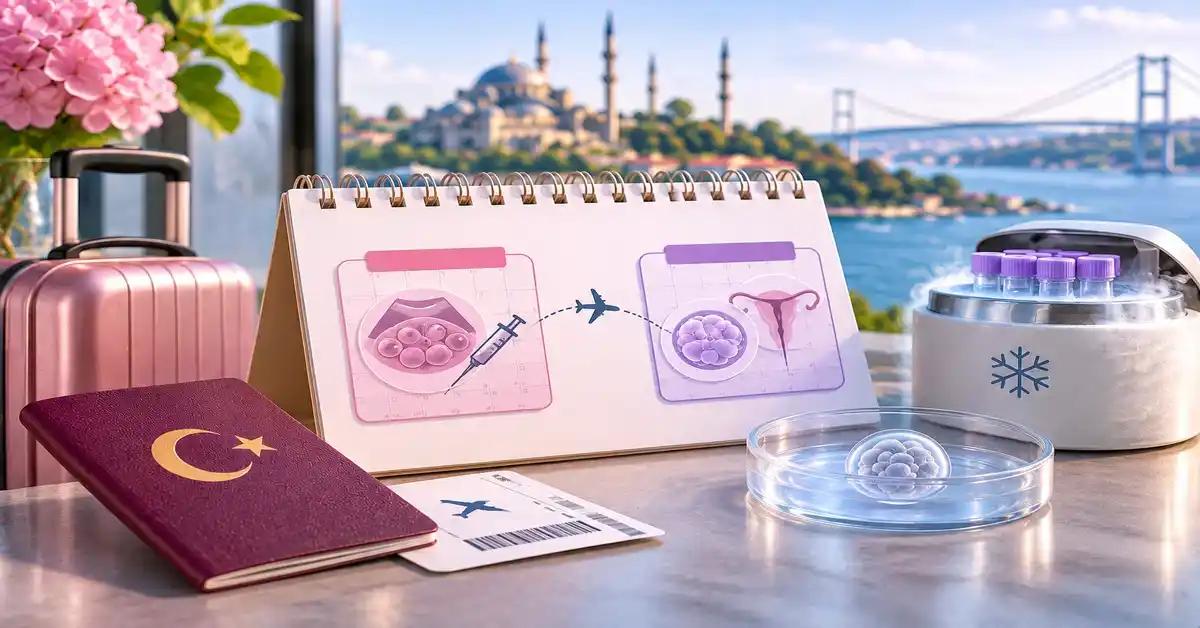
Not every international IVF program is completed in one trip with egg retrieval and embryo transfer during the same visit.
Some treatment plans are intentionally divided into two trips to Turkey:
Trip 1: ovarian stimulation, egg retrieval, fertilization, embryo development, and embryo freezing.
Trip 2: endometrial preparation and a later return to Turkey for frozen embryo transfer.
This may be planned from the beginning, particularly when embryos will undergo genetic testing, or a freeze-all decision may be made during treatment for clinical reasons.
A two-trip plan does not necessarily mean that treatment is more complicated. It can separate embryo creation from uterine preparation and allow the patient to recover at home between stages.
Fertiliv helps international patients coordinate each treatment visit separately so that flights and accommodation follow the actual medical pathway.
When Does a Two-Trip IVF Plan Make Sense?
Two trips may be considered when:
A freeze-all strategy is planned
Embryos will undergo PGT
There is a high risk of ovarian hyperstimulation syndrome
The endometrium is not suitable for transfer in the stimulation cycle
A uterine issue needs treatment before transfer
Embryo creation and embryo transfer are intentionally separated
The patient prefers returning home rather than remaining in Turkey for an extended period
A freeze-all strategy is specifically recommended in selected high-risk situations to reduce late-onset OHSS risk, but it is not automatically the best strategy for every patient.
Read also: One or Two Trips to Istanbul for IVF: Which Plan Fits Your Treatment?
Trip One: Creating and Freezing Embryos
The first visit generally focuses on completing the IVF laboratory stage.
It may include:
Cycle start
Baseline assessment and treatment planning.
Ovarian stimulation
Medication with ultrasound and selected laboratory monitoring.
Final trigger
Scheduled when follicles are ready.
Egg retrieval
Oocytes are collected.
Fertilization and embryo culture
Embryos are monitored in the laboratory.
Embryo freezing
Suitable embryos are cryopreserved for later use.
When PGT is performed, embryos may be biopsied at the appropriate developmental stage and then frozen while results are pending.
Must the First Trip Begin on Cycle Day One?
Not always.
Starting Treatment in Turkey
The patient may arrive around the beginning of the cycle for baseline ultrasound, testing, medication planning, and stimulation.
This usually creates a longer first stay.
Starting Stimulation at Home
Selected patients may be able to begin stimulation and complete early monitoring in their home country before traveling to Turkey for the final stage and retrieval.
This can shorten the first visit but requires reliable monitoring and rapid communication of results.
Read also: Can You Start IVF in Your Home Country and Complete Treatment in Turkey?
When Should You Book the First Flight?
Before stimulation, the retrieval date is generally an estimate rather than a confirmed day.
As follicular monitoring progresses, the travel window becomes more predictable.
If stimulation begins at home, a changeable ticket can therefore be particularly useful.
If the entire cycle begins in Turkey, the outbound flight can often be booked earlier because the treatment start is usually more predictable than the retrieval date.
Read also: When Should You Book Flights and Hotels After Starting an IVF Plan in Turkey?
When Can You Return Home After the First Trip?
If the plan is freeze-all, you generally do not need to remain in Turkey until embryo transfer.
The return date depends on:
Recovery after retrieval
Ovarian response
Symptoms requiring follow-up
Physician instructions
Any additional planned procedure
When medically stable, many international patients can return home after the required post-retrieval follow-up rather than waiting for PGT results or the next transfer cycle in Turkey.
Avoid fixing your return flight immediately after retrieval without discussing the recovery plan.
What Happens to the Embryos Between Trips?
Frozen embryos remain in cryostorage under the laboratory's identification, traceability, documentation, and cryopreservation procedures.
If genetic testing is being performed, results can often be reviewed while the patient is back in her home country.
If no PGT is planned, the time between trips can be used for recovery and preparation for frozen embryo transfer.
How Long Is the Gap Between the Two Trips?
There is no single standard interval.
The second trip may take place in a later menstrual cycle, or a longer interval may be required depending on:
Recovery after stimulation
Menstrual timing
PGT results
Endometrial condition
Treatment of a uterine finding
Personal travel circumstances
For this reason, booking the second trip too early may create unnecessary flight changes.
What Happens Between the Two Trips?
This period can be used to:
Recover after stimulation
Review embryo-development results
Receive PGT results when applicable
Select the next treatment strategy
Complete required testing
Decide on the FET protocol
Obtain medication
Plan travel for the second visit
If another uterine procedure is clinically required, it may be completed before transfer preparation.
Trip Two: Frozen Embryo Transfer
The second trip is often shorter than the stimulation and retrieval visit, particularly when endometrial preparation is performed at home.
Preparing at Home
Selected patients can undergo ultrasound, endometrial assessment, selected hormone testing, and medication preparation locally.
Results are then reviewed before travel is finalized.
Preparing in Turkey
Some patients prefer or need to complete endometrial preparation in Turkey.
This creates a longer second stay but may be useful when reliable local monitoring is unavailable.
Read also: Traveling to Turkey for Frozen Embryo Transfer: Timeline, Steps, and Preparation
Do Not Book Trip Two Based Only on the Menstrual Date
The beginning of a period helps create a schedule, but it does not automatically confirm the transfer date.
The team may also need to consider:
FET protocol
Endometrial development
Progesterone timing
Embryo developmental stage
Final clinical decision
Natural-cycle FET may require greater flexibility because timing depends on ovulation.
Programmed FET can sometimes offer greater scheduling control but still depends on the treatment protocol.
What Changes When PGT Is Included?
PGT commonly fits naturally into a two-trip structure.
A typical pathway is:
Trip 1: stimulation → retrieval → fertilization → embryo development → biopsy → freezing.
Then:
At home: wait for and review genetic results.
Then:
Trip 2: endometrial preparation → travel → frozen embryo transfer.
The American Society for Reproductive Medicine notes that PGT-A should not be considered routine for every IVF patient; its role should be individualized.
Budgeting for Trip One
Include more than the IVF procedure itself.
Potential costs include:
Flights
Accommodation
Local transportation
Food
Stimulation medication
Possible extra treatment days
Embryo freezing
Storage
Embryo biopsy and PGT when applicable
Some costs can depend on embryo number or storage requirements.
Budgeting for Trip Two
The second stage can include:
Another flight
Hotel
Local transportation
Endometrial preparation
Ultrasound and laboratory monitoring
Medication
Frozen embryo transfer
Any required assessment after arrival
When comparing treatment costs, therefore, consider the whole pathway through embryo transfer, not only the retrieval cycle.
Read also: Unexpected Costs During an IVF Trip to Turkey: How Can You Avoid Them?
Does the Male Partner Need to Travel Twice?
Not necessarily.
The male partner may be required during the first trip for sperm collection or other treatment-related requirements.
His presence during the second trip may not always be medically necessary.
Confirm this before automatically booking two trips for both partners.
Can Two Trips Become Three?
Yes, although this is not automatically expected.
A third visit may become necessary if:
A uterine problem requires separate treatment
Embryo transfer is postponed
The endometrium is not ready
Visa or personal circumstances interfere
Another medical issue appears
It is therefore more useful to think of IVF as a series of treatment stages rather than two permanently fixed flight dates.
Is Two-Trip IVF Always Better?
No.
When fresh embryo transfer is medically appropriate, treatment may sometimes be completed in one visit.
When embryos are intentionally frozen, genetically tested, or transferred later, two trips may be more practical.
The decision should follow the medical plan rather than travel convenience alone.

A Practical Two-Trip Timeline
Before Trip One
Send medical records
Identify missing tests
Confirm where stimulation begins
Arrange medication
Choose flexible flights and accommodation
Understand the freezing strategy
During Trip One
Monitor stimulation
Schedule final trigger
Complete egg retrieval
Follow fertilization and embryo development
Freeze suitable embryos
Complete biopsy if required
Confirm when you can return home
Between Trips
Recover
Review embryo results
Receive PGT results when applicable
Choose the FET protocol
Complete required testing
Begin preparation when instructed
Before Trip Two
Confirm endometrial readiness
Confirm progesterone timing
Finalize transfer date
Arrange travel
Prepare medication
Know when pregnancy testing will occur
After Transfer
In many cases, the patient can return home and complete pregnancy testing and follow-up locally according to the treatment team's instructions.
Two-Trip Checklist
Before committing to the plan, confirm:
Why are the embryos being frozen?
Is PGT planned?
What happens during trip one?
When can I return after retrieval?
Where will embryos be stored?
What are freezing and storage fees?
When will FET preparation begin?
Can endometrial preparation be done at home?
How long will trip two likely last?
Does my partner need both trips?
What is the expected cost of the second stage?
What happens if transfer is postponed?
Conclusion
A two-trip Turkey plan can be practical when IVF involves embryo freezing followed by frozen embryo transfer in a later cycle.
Trip one focuses on:
stimulation → egg retrieval → embryo creation → freezing
Trip two focuses on:
endometrial preparation → travel to Turkey → frozen embryo transfer
Between visits, the patient can return home, recover, review results, and prepare for the transfer stage.
Good planning does not mean booking both trips as early as possible. It means knowing when each medical stage is sufficiently clear to finalize travel.
Fertiliv helps international patients coordinate both treatment stages, remote monitoring, and travel so that each visit reflects what the treatment actually requires.
Frequently Asked Questions: How Do You Plan Two Trips to Turkey for IVF and Embryo Freezing?
Why Might IVF Require Two Trips?
When embryos are frozen and transfer is postponed to a later cycle, retrieval and embryo creation can be separated from frozen embryo transfer.
Do I Need to Stay in Turkey Until PGT Results Are Available?
Usually not. Results can generally be reviewed while you are back in your home country.
How Long Is the Gap Between Trips?
It varies according to recovery, menstrual timing, PGT results, endometrial status, and the treatment plan.
Can I Prepare for FET in My Home Country?
Selected patients can do so when the treatment team approves and reliable monitoring is available.
Does My Partner Need to Travel Twice?
Not always. This depends on medical and procedural requirements.
Should I Book the Second Trip at Egg Retrieval?
It is usually better to wait until the transfer plan and relevant results are sufficiently clear.
Does a Two-Trip Plan Always Cost More?
There are additional travel expenses, but the total depends on treatment, freezing, testing, and the duration of each trip.
Could I Need a Third Trip?
Yes, if transfer is postponed or another medical issue requires separate management, but this is not automatic.