
Intrauterine Insemination IUI: What It Is and Why It Is Used for Delayed Pregnancy

Manar Hegazy

Majd Eddin Khaled
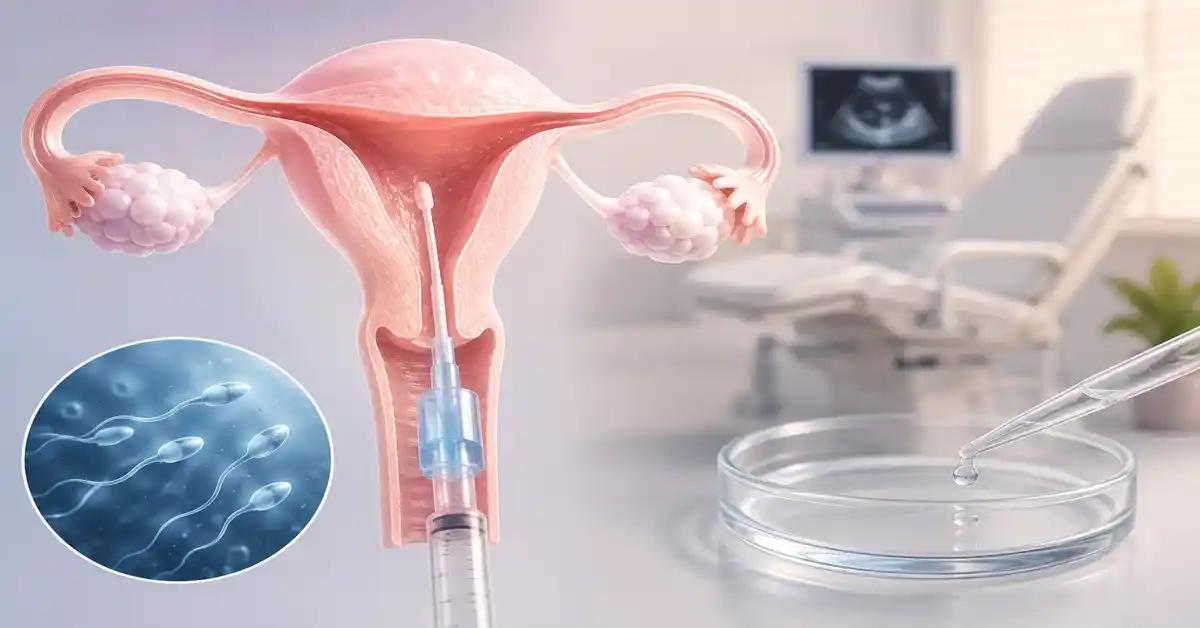
Intrauterine insemination, commonly called IUI, is a fertility treatment in which a prepared semen sample is placed directly inside the uterus close to ovulation. The aim is to shorten the distance sperm need to travel and improve the timing between sperm and egg. It is less complex than IVF or ICSI, but it still needs careful patient selection, ultrasound timing, and semen preparation.
The difference between IUI, timed intercourse, and ICSI
Timed intercourse depends on identifying the fertile window and having intercourse at the right time. IUI adds laboratory sperm preparation and places motile sperm directly inside the uterus. ICSI is different because fertilization happens in the laboratory after egg retrieval, with one sperm injected into one mature egg. This makes IUI an intermediate option between natural attempts and laboratory fertilization.
Fertility cases where IUI may be suitable
IUI may be suitable when the fallopian tubes are open, ovulation is present or can be induced, and semen quality is acceptable or only mildly reduced. It may be discussed in selected cases of unexplained infertility, mild ovulation disorders, mild male factor, or difficulty with timing intercourse. The key is that IUI should be selected because it fits the couple’s diagnosis, not because it is simply easier than IVF.
Fertility cases where IUI is usually not the best option
IUI is usually not appropriate when both tubes are blocked, sperm count or motility is severely reduced, ovarian reserve is very low, female age makes waiting risky, or several well-planned IUI attempts have already failed. In these situations, IVF or ICSI may be more realistic because fertilization can be managed in the laboratory.
IUI Treatment Steps from Cycle Start to Pregnancy Test
An IUI cycle usually includes pre-treatment evaluation, ovulation monitoring, semen preparation, the insemination procedure, and waiting for the pregnancy test. Although the procedure itself is simple, success depends on timing, egg development, sperm quality after preparation, and whether the uterus and tubes are suitable for this treatment.
Pre-IUI evaluation and couple readiness
Before starting IUI, the doctor needs to confirm that the couple is a good candidate. Evaluation may include female age, infertility duration, menstrual regularity, ovulation pattern, ultrasound assessment of the uterus and ovaries, tubal assessment when needed, and semen analysis for the male partner. Starting IUI without understanding tubal status and semen quality can reduce the value of the cycle.
Ovulation induction and follicle monitoring before IUI
Some IUI cycles are natural, while others use medications to stimulate ovulation. The goal is usually to develop one or a limited number of mature follicles. Ultrasound monitoring helps track follicle growth, and a trigger injection may be used to time ovulation more precisely. Careful monitoring is important because excessive response can increase the risk of multiple pregnancy.
Semen preparation and the IUI procedure
On the day of IUI, the semen sample is processed in the laboratory to concentrate motile sperm and remove unwanted elements. The prepared sample is then placed inside the uterus using a thin catheter. The procedure is usually quick and does not require anesthesia. Afterward, the patient can often return to normal daily activity, while following the medication and testing instructions.
IUI Cost Factors and What Is Included in the Price
IUI cost is not one fixed number. It varies by country, clinic, monitoring plan, medication needs, ultrasound visits, laboratory preparation, and additional tests. For this reason, couples should ask what the quoted price includes rather than comparing prices without knowing the details. IUI may appear lower-cost than IVF or ICSI, but the final cycle cost can increase if medications, monitoring, or tests are added.
Main items that influence IUI cost
IUI pricing may include consultation, ultrasound monitoring, ovulation tracking, semen preparation, and the insemination procedure. Some clinics include several items in one package, while others charge separately. The most important questions are whether ultrasound monitoring, sperm washing, blood tests, and extra follow-up visits are included.
How medications and tests affect IUI cost
Medications can change the final cost significantly. Some patients use oral tablets only, while others need injections and closer monitoring. Additional costs may also appear if tubal testing, repeat semen analysis, hormone tests, or infection evaluation is needed. Therefore, IUI cost should be understood as the total cycle cost, not only the insemination fee.
Why the cheapest IUI price is not always the best value
A low price is not always better if monitoring is limited, ovulation timing is unclear, or semen preparation quality is not explained. IUI is simple, but it is timing-sensitive. A good plan combines reasonable cost, proper monitoring, sperm preparation, correct patient selection, and a clear decision point for moving to the next treatment if needed.
| Cost item | Why it matters | Always needed? |
|---|---|---|
| Consultation and assessment | Confirms whether IUI is suitable | Usually yes |
| Ultrasound monitoring | Helps time ovulation | Usually yes |
| Ovulation medication | Depends on response and age | Case-based |
| Semen preparation | Concentrates motile sperm | Yes |
| Additional testing | Clarifies tubes, hormones, or semen | When indicated |
Real IUI Success Rates and What Affects the Result
IUI success rates vary widely. Pregnancy chance depends on female age, infertility diagnosis, whether fertility medications are used, and semen quality after preparation. In suitable cases, per-cycle success is often discussed around 10–20%, but it may be lower or higher depending on the couple’s individual profile.
Factors that improve IUI success rates
IUI is more likely to work when the female partner is younger, tubes are open, ovulation is reliable, the prepared sperm count is adequate, and infertility duration is not very long. Ovulation medication may improve pregnancy chance in selected cases, but it must be used carefully to avoid excessive follicle development and multiple pregnancy risk.
Factors that lower IUI success rates
Success is lower when female age is advanced, ovarian reserve is low, tubes are blocked, endometriosis is severe, the endometrium is not suitable, sperm quality is poor after preparation, or several previous IUI cycles have failed. IUI cannot solve severe fertilization problems or bypass blocked tubes.
How many IUI attempts before moving to IVF or ICSI?
The number of attempts depends on age, diagnosis, semen quality, ovarian reserve, and infertility duration. Some couples may try about three well-planned cycles when the indicators are favorable. Others should move faster to IVF or ICSI when time is limited or the chance of IUI success is low. The plan should be reviewed after each attempt.

IUI Risks and Limits Compared With IVF and ICSI
IUI is generally a simple and low-intervention procedure, but it has limits. Mild cramping or spotting may occur, and the use of ovulation medication may increase the chance of multiple pregnancy. IUI also does not guarantee fertilization, because sperm must still reach and fertilize the egg inside the body.
Ovulation medication risks and multiple pregnancy with IUI
The main reason for monitoring an IUI cycle is to avoid too many mature follicles. If several eggs develop, the risk of twins or higher-order pregnancy may rise, which can increase pregnancy complications. The doctor may cancel or adjust the cycle if ovarian response is too high.
IUI limits in severe sperm problems and blocked tubes
IUI requires enough motile sperm after preparation and at least one open tube. When semen quality is severely reduced or the tubes are blocked, IUI usually has limited value. IVF or ICSI may be more appropriate because fertilization is handled outside the body.
When IVF or ICSI is better than IUI
IVF or ICSI may be better when female age is advanced, ovarian reserve is low, tubes are blocked, sperm quality is severely reduced, IUI has failed repeatedly, or embryo testing is needed in selected situations. The decision should compare real success chances, not just procedure complexity or cost.
Fertiliv’s Approach to Choosing IUI and Planning the Next Step
At Fertiliv, IUI is not presented as a universal treatment for delayed pregnancy. It is chosen when the basic conditions for success are present. The aim is to avoid losing time on a treatment that does not fit the diagnosis, while also avoiding unnecessary movement to advanced treatment when a simpler option is still reasonable.
Couple evaluation before deciding on IUI
The plan begins with evaluating both partners: female age, ovarian reserve, ovulation, tubal status, uterus, semen analysis, and infertility duration. If the results support IUI, a clear cycle plan can be made. If key factors strongly reduce success, the couple is guided toward a more effective option.
Preparing an IUI cycle for better timing and success
A strong IUI plan includes the right stimulation protocol, ultrasound monitoring, ovulation timing, quality semen preparation, and clear instructions after the procedure. The procedure itself may be quick, but the preparation around it determines much of its value.
When Fertiliv recommends moving from IUI to ICSI
Moving from IUI to ICSI may be recommended after failed well-planned IUI attempts, unsuitable semen results, advanced female age, low ovarian reserve, tubal disease, or other factors that make IUI less efficient. This move is not a failure; it is a rational adjustment based on results.
Read about: Intrauterine Insemination (IUI): When Is It Recommended?
Conclusion
IUI can be a good option for selected couples, especially when the tubes are open, ovulation can be monitored, semen quality is acceptable, and no severe fertility factor is present. However, it is not guaranteed, and its true success rate depends on age, diagnosis, sperm quality, ovulation timing, and cycle management. Cost should also be understood as the full treatment pathway, including monitoring, medications, tests, and semen preparation.
Frequently Asked Questions: Intrauterine Insemination IUI
Is IUI painful?
Usually no. It may cause mild cramping or brief discomfort similar to a gynecologic exam, and anesthesia is usually not needed.
Is IUI better than ICSI?
Not always. IUI is simpler, but it suits selected cases. ICSI is often better with blocked tubes, severe sperm problems, or limited time.
How long does an IUI cycle take?
It usually follows the menstrual cycle, with the pregnancy test done about two weeks after insemination.
What is the real success rate of IUI?
It varies by age, diagnosis, sperm quality, and medications. In suitable cases, it is often discussed around 10–20% per cycle.
Does IUI cost include medications and tests?
Not always. Some clinics charge medications, tests, and monitoring separately, so couples should ask what is included before starting.