
When Does IUI Work Best for Pregnancy?

Manar Hegazy

Majd Eddin Khaled
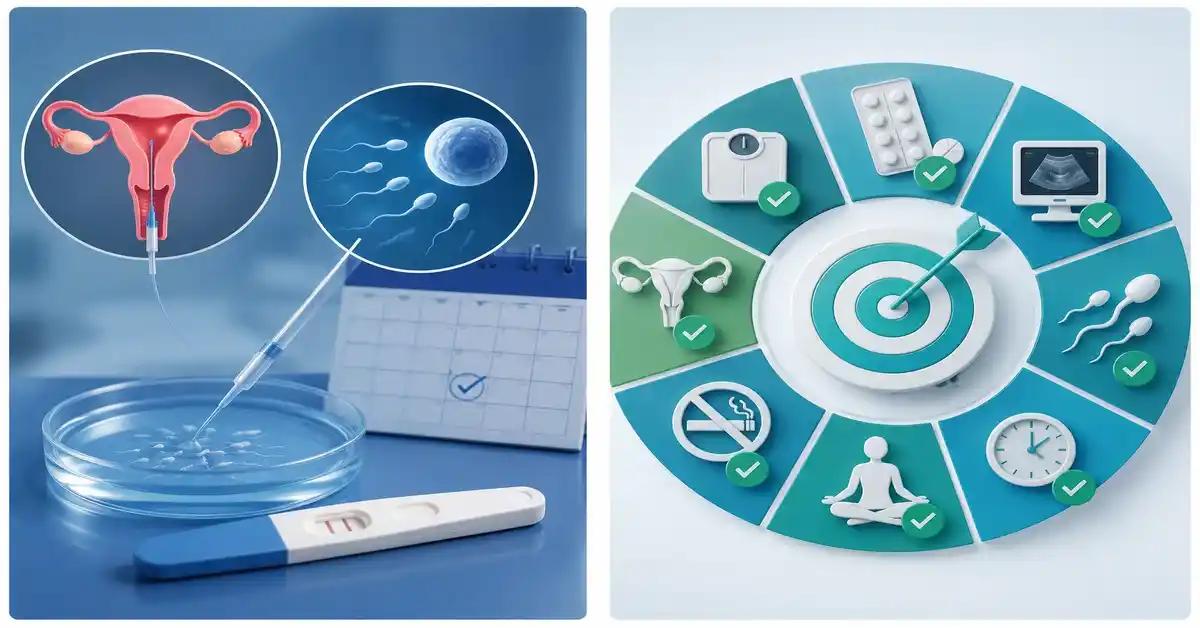
IUI works best when the basic conditions for fertilization inside the body are still present: ovulation is occurring, at least one fallopian tube is open, the uterus is suitable, and the prepared semen sample contains enough motile sperm. IUI does not create fertilization in the laboratory; it improves sperm placement and timing. This is why correct patient selection is the foundation of success.
IUI success depends on choosing the right medical case
IUI is not suitable for every couple with delayed pregnancy. It is more reasonable in mild or selected cases, such as unexplained infertility, ovulation problems that respond to treatment, or mild male factor infertility. When the cause is severe, repeated IUI attempts may waste valuable time.
IUI needs open tubes and reliable ovulation
Because fertilization still occurs inside the body, the egg must be released and the fallopian tube must allow sperm and egg to meet. If ovulation is irregular, it can be supported and monitored. If tubal disease is suspected, tubal assessment becomes important before relying on IUI.
IUI success is not guaranteed in the first attempt
Even in suitable cases, IUI does not guarantee pregnancy in the first cycle. It should be planned as a limited, reviewed treatment pathway rather than an open-ended series of attempts. If pregnancy does not occur after well-planned cycles, the next treatment step should be reconsidered.
Female Age and Ovarian Reserve as IUI Success Factors
Female age is one of the strongest predictors of IUI outcome because egg quality declines with age. Ovarian reserve also helps determine how much time is available for lower-intervention treatment. Published reviews show better IUI outcomes in younger women and a clearer decline after age 40.
Younger female age improves IUI pregnancy chances
IUI tends to perform better when the female partner is younger and ovulation is healthy. This does not mean IUI is impossible at older ages, but it does mean the decision must be realistic. When time is limited, IVF or ICSI may be more appropriate than several low-probability IUI attempts.
Ovarian reserve helps decide whether to try IUI or move faster
Ovarian reserve does not alone determine pregnancy, but it helps guide treatment speed. If reserve is reassuring and the diagnosis fits IUI, a trial may be reasonable. If ovarian reserve is low, several IUI cycles may not be the best use of time.
Egg quality matters more than follicle number alone
Having more than one follicle may seem encouraging, but safe and appropriate stimulation is more important than aggressive stimulation. The goal is to improve the chance of pregnancy while avoiding excessive follicle development and multiple pregnancy risk.
Sperm Quality and Semen Preparation in IUI Success
Sperm quality after preparation is central to IUI success. The treatment places concentrated motile sperm in the uterus, but sperm still need to travel and fertilize the egg inside the body. IUI is therefore better suited to mild male factor rather than severe sperm problems.
Total motile sperm after washing affects IUI results
The key number is not only the original semen analysis, but the number of motile sperm remaining after washing and preparation. If enough motile sperm remain, IUI becomes more reasonable. If the prepared sample is very weak, ICSI may be more effective.
Sperm motility and morphology influence IUI suitability
Motility matters because sperm must still move toward the fallopian tube after insemination. Morphology may also influence fertilization ability. Mild abnormalities may still be compatible with IUI, while severe combined sperm problems often reduce the chance.
Laboratory preparation improves sperm concentration
Semen preparation helps separate and concentrate motile sperm, but it cannot fully correct a severely poor sample. Laboratory quality, abstinence timing, sample handling, and preparation method all matter in making the final insemination sample as useful as possible.

Ovulation Timing and Stimulation to Increase IUI Pregnancy Chances
Timing is a major part of IUI success because the egg is fertilizable for a limited time after ovulation. The goal is to place sperm inside the uterus when ovulation is about to happen or has just occurred. Ovulation medication may improve chances in selected cases, but it must be monitored carefully.
Follicle monitoring improves IUI timing
Ultrasound monitoring helps track follicle size, follicle number, and endometrial development. When a follicle is mature, timing can be planned more accurately. This avoids performing IUI too early or too late.
Ovulation induction can help selected IUI cycles
Oral medication or injections may be used when ovulation is irregular or when a controlled stimulation cycle is planned. The aim is not to produce too many eggs, but to create a safe and suitable ovulation window. Excessive response may require cycle cancellation or plan adjustment.
A receptive endometrium supports implantation after IUI
After fertilization, the embryo still needs a receptive uterine lining. Endometrial development, uterine cavity health, and timing all matter. If there are polyps, fibroids affecting the cavity, or a persistently thin lining, those factors may need treatment before repeating IUI.
Infertility Diagnoses That Make IUI More or Less Successful
The cause of infertility strongly affects whether IUI is worth trying. IUI can be useful when the problem is mild or functional, but it is less effective when there is a mechanical or severe fertility barrier. The best treatment is the one that fits the diagnosis.
Unexplained infertility may respond to well-selected IUI
In unexplained infertility, basic tests are reassuring, but pregnancy has not occurred. IUI with ovulation monitoring may be reasonable when the female partner is younger and infertility duration is not very long. If attempts fail, the plan should be reassessed rather than repeated indefinitely.
Mild ovulation disorders may improve with stimulated IUI
When the main issue is irregular ovulation, inducing and monitoring ovulation with IUI may improve the chance of pregnancy. However, this works best when tubes are open, semen quality is suitable, and no additional strong fertility factor is present.
Blocked tubes or severe sperm problems reduce IUI value
Blocked tubes prevent sperm and egg from meeting inside the body, which makes IUI ineffective. Severe sperm problems also reduce IUI value because sperm still need to reach and fertilize the egg. In these cases, IVF or ICSI is usually more realistic.
Read about: Intrauterine Insemination (IUI): When Is It Recommended?
Fertiliv’s Medical Plan for Improving IUI Success
IUI success comes from matching the right diagnosis with careful timing and monitoring. If the female partner is at a suitable age, tubes are open, ovulation can be managed, and semen quality is acceptable after preparation, IUI may be a reasonable treatment step. If those factors are weak, moving to a more effective option may be wiser.
When IUI is a reasonable fertility decision
IUI is reasonable when there is a real chance of fertilization inside the body. This includes selected mild cases with a clear number of planned attempts and a defined review point. Couples should understand that IUI is an opportunity, not a guarantee.
When to move from IUI to ICSI
Moving to ICSI should be considered after failed well-planned IUI attempts, advanced female age, low ovarian reserve, poor post-wash semen quality, tubal problems, or uterine factors that reduce IUI success. This is not failure; it is a logical adjustment of the treatment plan.
How Fertiliv helps increase IUI pregnancy chances
At Fertiliv, the decision begins with evaluating both partners. Ovulation, tubes, uterus, semen analysis, age, and ovarian reserve are reviewed before choosing IUI. If IUI is suitable, stimulation, monitoring, timing, and semen preparation are planned carefully to give the couple the best realistic chance.
Frequently Asked Questions: When Does IUI Work?
What is the most important factor for IUI success?
The main factors are female age, open tubes, good ovulation, enough motile sperm after preparation, and accurate timing.
Can IUI work on the first try?
Yes, it can, but it does not guarantee pregnancy. Many couples need a limited number of planned attempts before reassessment.
Does ovulation induction improve IUI success?
It may help in selected cases, but it must be monitored carefully to avoid excessive follicle development and multiple pregnancy risk.
Can IUI work with poor semen quality?
Mild male factor may still be suitable. Severe sperm count or motility problems often make ICSI a better option.
When should IUI not be repeated?
It should not be repeated many times when cycles fail despite good planning, or when age, ovarian reserve, semen quality, or tubal status make success unlikely.