
Understanding the Role of Hormones in Sperm Production

Manar Hegazy

Majd Eddin Khaled
Sperm production is a complex and highly sensitive process. This process depends entirely on the delicate balance of hormones. Hormones are chemical messengers that control every aspect of sperm production. When hormones are balanced, the body produces healthy sperm in sufficient quantities. But when there is a disruption in this balance, sperm quality and quantity can decrease significantly. At Fertiliv IVF Center, we see daily men suffering from sperm production problems due to hormonal imbalance. This article explains the complex process of sperm production and the role of hormones in it.
The Journey of Sperm Production: An Amazing Process That Takes 3 Months
Sperm production is a long and complex process. This process begins in the testicles and takes approximately 74 days (about 3 months) from start to finish. During this period, sperm goes through several stages of growth and maturation.
What Is the Process of Sperm Formation (Spermatogenesis)?
The process of sperm formation (Spermatogenesis) is the process by which sperm is produced from stem cells. This process occurs in the tiny tubes inside the testicles called "seminiferous tubules."
The process begins when:
- The testicles receive hormonal signals from the pituitary gland
- Stem cells (germ cells) are activated and begin to divide
- Cells gradually develop from simple cells into mature sperm
- Sperm mature and gain the ability to move
This process is very complex and requires a delicate balance of hormones. If you suspect a problem in sperm production, contact the Fertiliv team.
The Timeline for Sperm Maturation
The stages of sperm maturation occur as follows:
- First Stage (0-8 days): Stem cells divide and develop into primary cells
- Second Stage (8-16 days): Primary cells divide into secondary cells
- Third Stage (16-64 days): Secondary cells develop into immature sperm
- Fourth Stage (64-74 days): Sperm mature and gain the ability to move
This timeline is very important to understand why treatment may take several months to show results.
The Hormonal Team Responsible for Production
Sperm production depends on several hormones working together in precise coordination. Each hormone has a specific and crucial role.
The Role of FSH and LH Hormones as Primary Regulators
FSH (Follicle-Stimulating Hormone) and LH (Luteinizing Hormone) are the primary hormones responsible for regulating sperm production:
FSH (Follicle-Stimulating Hormone):
- Produced in the pituitary gland
- Stimulates helper cells in the testicles (Sertoli cells)
- Controls the growth and development of sperm
- Affects sperm quality and quantity
LH (Luteinizing Hormone):
- Also produced in the pituitary gland
- Stimulates cells between the seminiferous tubules (Leydig cells)
- Stimulates testosterone production
- Testosterone is the basic fuel for sperm production
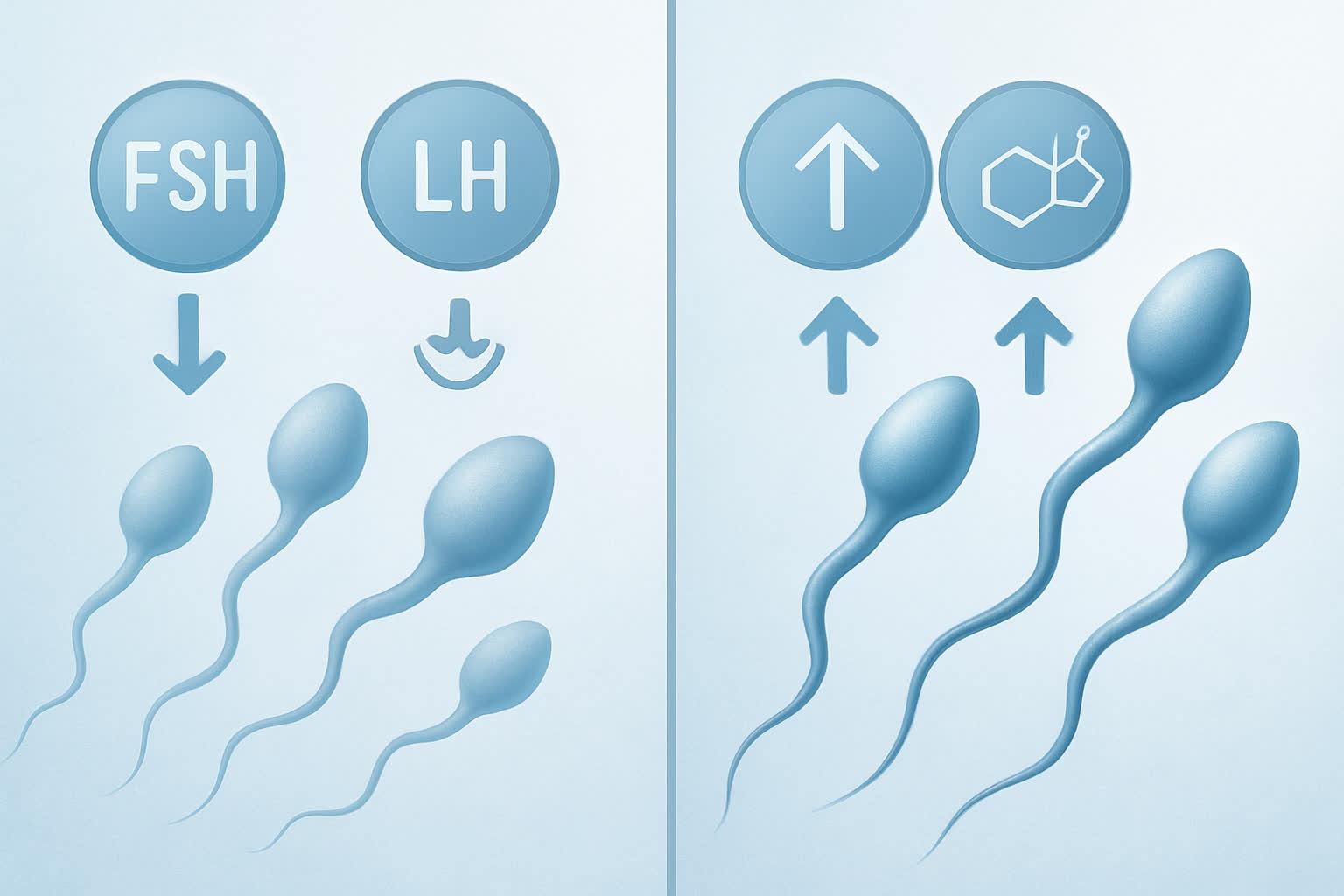
When FSH and LH levels drop, sperm production decreases significantly.
The Importance of Testosterone as Basic Fuel for the Process
Testosterone is the "fuel" that drives the sperm production process. Without adequate testosterone levels, the testicles cannot produce healthy sperm.
The role of testosterone in sperm production:
- Stimulates Sertoli cell activity
- Supports sperm growth and development
- Maintains the health of seminiferous tubules
- Improves sperm motility
- Affects the shape and structure of sperm
Low testosterone levels can cause a significant decrease in sperm production.
How Does the Body Maintain a Delicate Balance for Sperm Production?
The body has a complex system to maintain the delicate balance of hormones responsible for sperm production.
A Simplified Explanation of the Feedback Mechanism
The feedback system works as follows:
- The hypothalamus sends a signal to the pituitary gland
- The pituitary gland produces FSH and LH
- FSH and LH stimulate the testicles to produce sperm and testosterone
- When testosterone levels reach a certain level, the body sends a stop signal
- This signal reduces FSH and LH production
- In this way, balance is maintained
This system is called "negative feedback" and it ensures that hormone levels remain within the normal range.
What Happens When This Hormonal Balance Is Disrupted?
When there is a disruption in the feedback system, several problems may occur:
- Elevated FSH and LH: May occur if the testicles do not produce enough hormones
- Low FSH and LH: May occur if there is an elevation in other hormone levels
- Hormonal instability: May cause fluctuations in sperm production
Consult a specialist if you suffer from symptoms of hormonal imbalance.
How Does Hormonal Defect Affect Sperm Quality and Quantity?
Hormonal defect can affect sperm in different ways.
The Effect of Hormone Deficiency on Sperm Count and Motility
Hormone deficiency (especially FSH, LH, and testosterone) may cause:
- Low sperm count (Oligospermia): Decreased number of sperm in seminal fluid
- No sperm (Azoospermia): No sperm present in seminal fluid
- Poor sperm motility (Asthenospermia): Sperm do not move correctly
- Abnormal sperm shape (Teratospermia): Sperm have abnormal shape
All these problems may cause difficulty in achieving natural conception.
The Negative Effect of Elevated Other Hormones (Such as Estrogen)
Elevated levels of some hormones can also cause problems:
- Elevated estrogen: Suppresses FSH and LH production, reducing sperm production
- Elevated prolactin: Suppresses sexual desire and sexual performance, reduces sperm production
- Elevated cortisol (stress hormone): Suppresses testosterone and sperm production
Practical Tips to Support Healthy Hormonal Sperm Production
There are several ways to support healthy hormonal sperm production.
The Role of Proper Nutrition and Healthy Lifestyle
Proper nutrition and healthy lifestyle play an important role in supporting sperm production:
Important Foods:
- Foods rich in zinc (red meat, poultry, fish, oysters)
- Foods rich in vitamin C (citrus fruits, tomatoes, peppers)
- Foods rich in vitamin E (nuts, seeds, vegetable oils)
- Foods rich in selenium (fish, eggs, garlic)
- Foods rich in proteins (poultry, fish, eggs, legumes)
Healthy Lifestyle:
- Exercise regularly (3-4 times per week)
- Get adequate sleep (7-9 hours daily)
- Reduce stress and psychological pressure
- Avoid smoking and alcohol
- Maintain a healthy weight
Avoiding Environmental Factors Harmful to Fertility
There are several environmental factors that can harm sperm production:
- Heat exposure: Avoid hot baths, tight clothing, and prolonged sitting
- Chemical exposure: Avoid pesticides, solvents, and heavy metals
- Radiation exposure: Reduce mobile phone and computer use
- Environmental pollution: Avoid polluted areas as much as possible
- Harmful medications: Avoid medications that may affect fertility
Understanding the role of hormones in sperm production is the key to understanding male fertility. Sperm production is a complex process that depends on the delicate balance of hormones. When there is a disruption in this balance, sperm quality and quantity can decrease significantly. Understanding this process and the factors that affect it can help improve fertility and restore hope.
If you suffer from fertility problems, it is important to understand the role of hormones in this problem. Hormonal defect may be the root cause of the problem. Early diagnosis and proper treatment can help restore fertility and general health. At Fertiliv IVF Center, we have expertise in diagnosing and treating fertility problems related to hormones.
If you want a deeper understanding of the role of hormones in your fertility, contact the Fertiliv team via WhatsApp for specialized consultation and comprehensive assessment of your condition.