The Difference Between IVF and ICSI

Manar Hegazy

Majd Eddin Khaled
Often, people use the terms "in vitro fertilization" and "intracytoplasmic sperm injection" interchangeably when discussing infertility treatment and fertility solutions, which leads to confusion among many about what each means or whether they refer to the same procedure. In reality, these two terms are not contradictory or identical, but rather one is related to the other in a complex way. In this comprehensive article, we will clarify the fundamental difference between IVF and ICSI, explain how fertilization occurs in each method, and discuss the medical conditions where one technique is preferred over the other.
Introduction: Understanding Assisted Reproductive Technologies
Assisted reproductive technologies have revolutionized the field of infertility and fertility treatment. With advances in science and medical technology, we now have multiple options to help couples achieve their dream of having children. Understanding the difference between these techniques helps couples make informed decisions with their medical team.
Why Is It Important to Understand the Difference Between IVF and ICSI?
Understanding the difference between in vitro fertilization and intracytoplasmic sperm injection helps couples understand the treatment options available to them. Each technique has specific indications for use and particular clinical applications. Choosing the right technique can significantly improve treatment success rates.
What Is In Vitro Fertilization (IVF)?
In vitro fertilization, scientifically known as "IVF" or "In Vitro Fertilization," is one of the most important and effective medical solutions for treating various and complex infertility cases.
Steps of the IVF Process
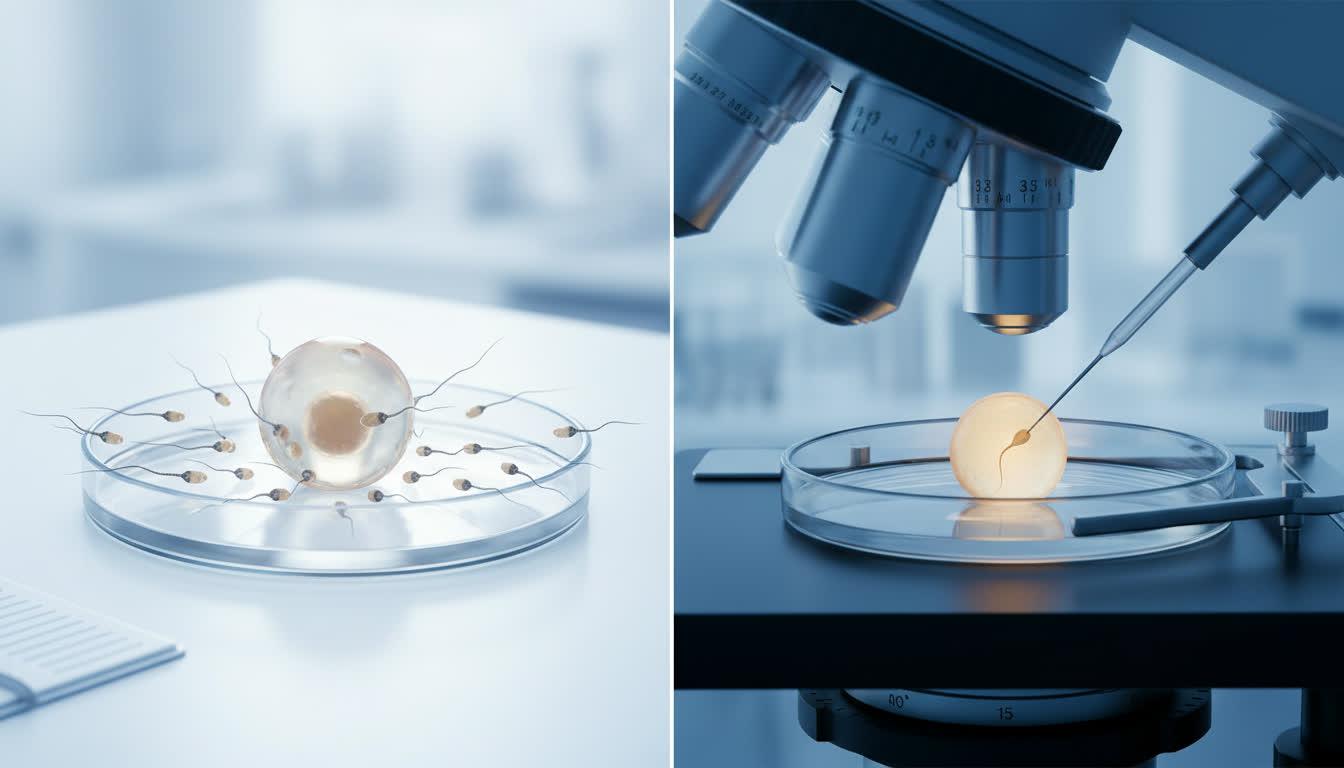
The IVF process begins by extracting mature eggs from the woman's ovary after stimulating them with advanced hormonal medications. These eggs are then placed in a special glass dish with sperm collected from the husband. Here, fertilization occurs naturally, just as it happens inside the human body, where the sperm attempts to penetrate and unite with the egg naturally. After that, embryos are monitored in the laboratory for two to five days, and the strongest and healthiest embryo is selected for transfer to the uterus.
Conditions for Using IVF
IVF is used in cases of blocked or damaged fallopian tubes. It is also used in cases of ovulation disorders and unexplained infertility. It is also used when sperm quality is normal and sufficient for natural fertilization. It is used in cases of genetic diseases that require embryo testing.
What Is Intracytoplasmic Sperm Injection (ICSI)?
Intracytoplasmic sperm injection (ICSI) is an abbreviation for "Intracytoplasmic Sperm Injection," a modern and advanced technique within in vitro fertilization, but it differs fundamentally in terms of the fertilization method and direct intervention.
How ICSI Works
In the intracytoplasmic sperm injection technique, fertilization does not occur naturally as in conventional IVF. Instead, a single sperm with good health and normal characteristics is carefully selected and injected directly into the egg using a very fine needle under a microscope with very high magnification. This direct intervention allows complete control over the fertilization process.
When Is ICSI Used?
ICSI is considered an important and modern development in the field of fertility and reproduction. It is used when there is difficulty in the sperm penetrating the egg naturally. It is also used when sperm quality is poor or the sperm count is very low.
The Fundamental Difference Between IVF and ICSI
The basic and fundamental difference between in vitro fertilization (IVF) and intracytoplasmic sperm injection (ICSI) lies in how the egg is fertilized and how the process is controlled.
Fertilization Method in IVF
In conventional in vitro fertilization (IVF), a large number of healthy sperm are placed with the egg in a special culture dish. Fertilization occurs naturally, just as it happens inside the human body. This method requires a good and sufficient quantity of healthy and motile sperm.
Fertilization Method in ICSI
In the intracytoplasmic sperm injection technique (ICSI), a single sperm is carefully selected and injected directly into the egg using very fine instruments under a microscope. This method is used when sperm count is low, sperm motility is poor, or sperm morphology is abnormal.
Detailed Comparison Between the Two Techniques
In IVF, fertilization occurs naturally and automatically, while in ICSI, the fertilization process is completely controlled. In IVF, a large number of sperm are used, while in ICSI, only one sperm is used. In IVF, fertilization rates are lower in cases of male factor infertility, while in ICSI, fertilization rates are higher in these cases.
When Is IVF Used and When Is ICSI Used?
ICSI is not used in all cases of in vitro fertilization, but only in cases that require direct intervention due to specific problems with sperm or male factor infertility.
Cases for Using Conventional IVF
Conventional IVF is preferred in cases of blocked or damaged fallopian tubes. It is also used in cases of ovulation disorders and unexplained infertility. It is used when sperm quality is normal and sufficient. It is used in cases of genetic diseases requiring embryo testing.
Cases for Using ICSI
ICSI is used in cases of severely low sperm count. It is also used in cases of poor sperm motility or severe sperm morphology abnormalities. It is also used in cases of failed fertilization in previous IVF attempts. You can explore treatment options with us to determine the right technique for your situation.
Success Rates: Is ICSI Better Than IVF?
This is a question many couples ask, but the answer is not as simple as it might seem.
Comparing Success Rates
ICSI does not always increase pregnancy chances compared to IVF. In cases of good sperm quality, success rates between IVF and ICSI are very similar. However, in cases of male factor infertility, using ICSI significantly increases fertilization chances.
Factors Affecting Success
Success rates of IVF and ICSI depend on multiple factors such as the woman's age, egg quality, and sperm quality. They also depend on uterine lining health and the general health status of both partners. Choosing the right technique based on careful evaluation increases success chances.
Why Isn't ICSI Used in All Cases?
ICSI is not considered the first choice for all cases, but is used only when necessary to avoid unnecessary interventions. Using ICSI in cases that don't need it may not improve success rates and may increase costs.
Financial and Practical Considerations
When choosing between IVF and ICSI, multiple financial and practical factors should be considered.
Cost Difference
The ICSI procedure is usually more expensive than conventional IVF due to the advanced equipment and expertise required. However, this cost difference may be justified in cases that truly need ICSI.
Time and Effort
Both techniques require similar time and effort from the patient. The main difference is in the laboratory and not in the patient's experience.
Although the terms "in vitro fertilization" and "intracytoplasmic sperm injection" are generally used to refer to procedures that occur outside the mother's body to achieve pregnancy, there is a clear and fundamental difference between the two methods in terms of how the egg is fertilized. In IVF, fertilization occurs naturally. While in ICSI, the fertilization process is completely controlled by injecting a single sperm into the egg. In short, ICSI is a development of IVF technology, not an alternative to it, and is used to improve fertilization chances in cases of male factor infertility, while the IVF method remains sufficient in many other cases.
At Fertiliv IVF Center, we believe that choosing the right technique is the key to success, based on careful and comprehensive evaluation of each case. Our highly experienced medical team accompanies you at every step of your journey toward parenthood, with a deep understanding of your health and emotional needs. We are here to support you on this important journey.

Comments (0)
There's no more comments