
Does Embryo Testing Harm Them or Reduce Success Chances?

Manar Hegazy

Majd Eddin Khaled
With the continuous and accelerating advancement in fertility medicine, preimplantation genetic testing for embryos (PGT) has become an important part of the treatment journey for many couples undergoing in vitro fertilization (IVF) or intracytoplasmic sperm injection (ICSI). However, there still exists widespread concern about this procedure, focusing on a fundamental and critical question: Does genetic testing negatively affect embryo health or pregnancy chances? In this comprehensive and detailed article, we will explain what embryo genetic testing is, how it is performed with precision, and whether it has any harmful effects on embryos or on implantation and pregnancy results.
What is Preimplantation Genetic Testing for Embryos (PGT)?
Embryo genetic testing is a precise and scientific analysis performed on one or more cells from an embryo before transfer to the uterus, with the goal of detecting any chromosomal or genetic abnormalities that could lead to implantation failure, miscarriage, or the birth of a child with a serious genetic disease.
When is Embryo Genetic Testing Performed?
This test is usually performed when the woman is advanced in age, there have been repeated miscarriages, there were previous failed IVF attempts, or when one or both partners carry a known genetic disease.
Different Types of Genetic Testing
- PGT-A: Screening for numerical chromosomal abnormalities
- PGT-M: Screening for specific genetic diseases
- PGT-SR: Screening for structural chromosomal rearrangements
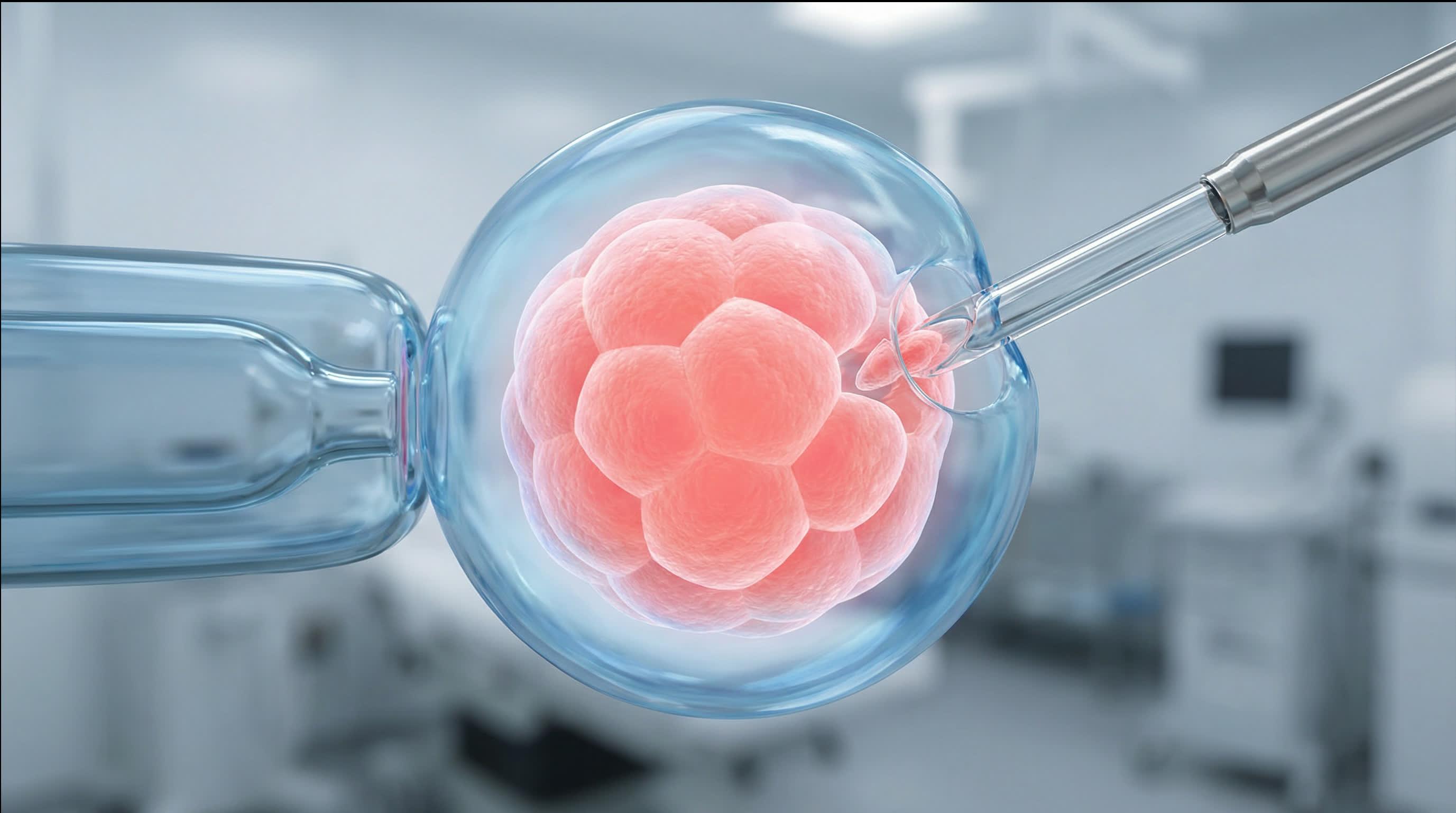
How is a Biopsy Taken from the Embryo?
Before we answer the main question, let us understand how embryo genetic testing is performed precisely and step by step.
Stage of Embryo Development in the Laboratory
The embryo is left to develop in the laboratory for 5 to 6 days after fertilization. At this critical stage, the embryo consists of hundreds of cells and is characterized by the presence of an outer layer (which becomes the placenta) and an inner cell mass (which becomes the actual fetus).
Taking a Biopsy from the Outer Layer of the Embryo
Using very precise instruments under a specialized and high-power microscope, a very small number of cells are taken from the outer layer of the embryo (which forms the placenta in the future), not from the inner mass that becomes the actual baby. The biopsy is only taken after the embryo reaches the appropriate and safe stage of cellular stability.
DNA and Chromosome Analysis
The cells taken are sent to the specialized laboratory for analysis of their chromosomal structure with very high precision. The process takes several days, during which embryos are either frozen or transferred in the same cycle if the medical condition allows.
Does Taking a Biopsy Affect Embryo Health?
What Reliable Scientific Studies Indicate
Many reliable and specialized scientific studies have shown that taking a biopsy from the outer layer of the embryo does not affect its ability to implant or develop normally and healthily, provided that the procedure is performed with high precision and using modern and reliable techniques.
The Embryo's Ability to Compensate and Regenerate
At the stage when the biopsy is taken, the embryo consists of hundreds of cells and can compensate for the missing cells without significant or noticeable impact on its health or normal development.
The Difference Between Safe and Incorrect Biopsy
If the biopsy is taken in an imprecise manner or from the wrong location, it could negatively affect the embryo. Therefore, expertise and modern and advanced equipment are key to safety and success.
Does Genetic Testing Reduce Pregnancy Chances?
Cases Where Testing May Reduce Chances
Yes, in some specific cases, if the number of embryos is very limited and all have been excluded due to chromosomal abnormalities, testing could lead to delayed pregnancy or even no embryo available for transfer in the same cycle. Also, embryo transfer in a later cycle after freezing may be slightly less effective than fresh transfer in some specific cases.
Cases Where Testing Increases Chances
No, but it increases pregnancy chances in many other cases that are well documented. In fact, many reliable and documented studies have proven that using genetic testing increases rates of successful pregnancy and live birth in women over 35, in cases of repeated miscarriage, and in previously failed IVF attempts.
The Reason Behind Increased Pregnancy Chances
Because testing helps select only embryos with normal and healthy chromosomal structure, which significantly reduces the risk of miscarriage and increases the chances of healthy and safe pregnancy.
Does Genetic Testing Affect Child Health After Birth?
Long-Term Studies on Child Health
There is no reliable scientific evidence indicating that children born from embryos that underwent genetic testing differ in general health, intelligence, or development from other children who did not undergo testing.
Medical Follow-up of Children Born from Tested Embryos
Additionally, children born from embryos that underwent genetic testing do not show noticeable differences in health or development compared to other children of the same age and environment.
Do All Embryos Need Genetic Testing?
Cases Where Genetic Testing is Recommended
No, not all embryos need genetic testing. Testing is recommended in the following specific and medically documented cases: advanced maternal age (over 35 years), family history of genetic diseases, repeated miscarriage, repeated IVF failure.
Cases Where Testing May Not Be Necessary
In cases of simple infertility or when there is a large number of healthy embryos, testing may not be necessary and could increase costs without clear and tangible benefits.
Can Genetic Testing Results Be Wrong?
Possibility of Errors in Genetic Testing
Yes, although such cases are very rare, results can sometimes be inaccurate, especially if the biopsy is very small or not taken from the correct and appropriate location.
Importance of Reviewing Results with Your Doctor
Therefore, results should always be reviewed with your specialized treating physician, and a final decision should not be made based on a single result, especially if it is unclear, blurry, or uncertain.
Genetic Testing in Specialized Centers
Importance of Expertise and Modern Equipment
Although the benefits of embryo genetic testing in improving pregnancy chances and preventing miscarriage cannot be denied, it is not a procedure without challenges and potential risks. In the hands of experts and in specialized centers like Fertiliv, testing is completely safe and does not affect embryo health.
Special Cases and Weak Embryos
However, in cases of very few or weak embryos, it may be preferable to avoid testing or reconsider the actual need for it after consulting with a specialized physician.
Conclusion and Key Points
In summary, genetic testing is not directly harmful to embryos, but it could affect pregnancy chances indirectly if there are no normal embryos available for transfer. At Fertiliv, we believe that every medical decision should be based on careful and comprehensive evaluation of each case, with the presence of a specialized team to ensure the best results with complete safety. You can contact us now to learn more about embryo genetic testing or visit the clinic directly for comprehensive consultation.
Frequently Asked Questions About Embryo Testing and Genetic Screening
Yes, genetic testing is completely safe when performed by a specialized and highly experienced team, and the biopsy taken is very small and does not affect the embryo.
The accuracy of genetic testing reaches 99% in detecting chromosomal abnormalities, but pregnancy success depends on other factors as well.
No, genetic testing is recommended in specific cases such as advanced age or repeated miscarriage, not for all couples.
Very rarely, but there is a very small possibility of error, especially in complex cases.